🥦 Nutrition & Nutrients
Weight gain
Calories
April 1, 2026
Share
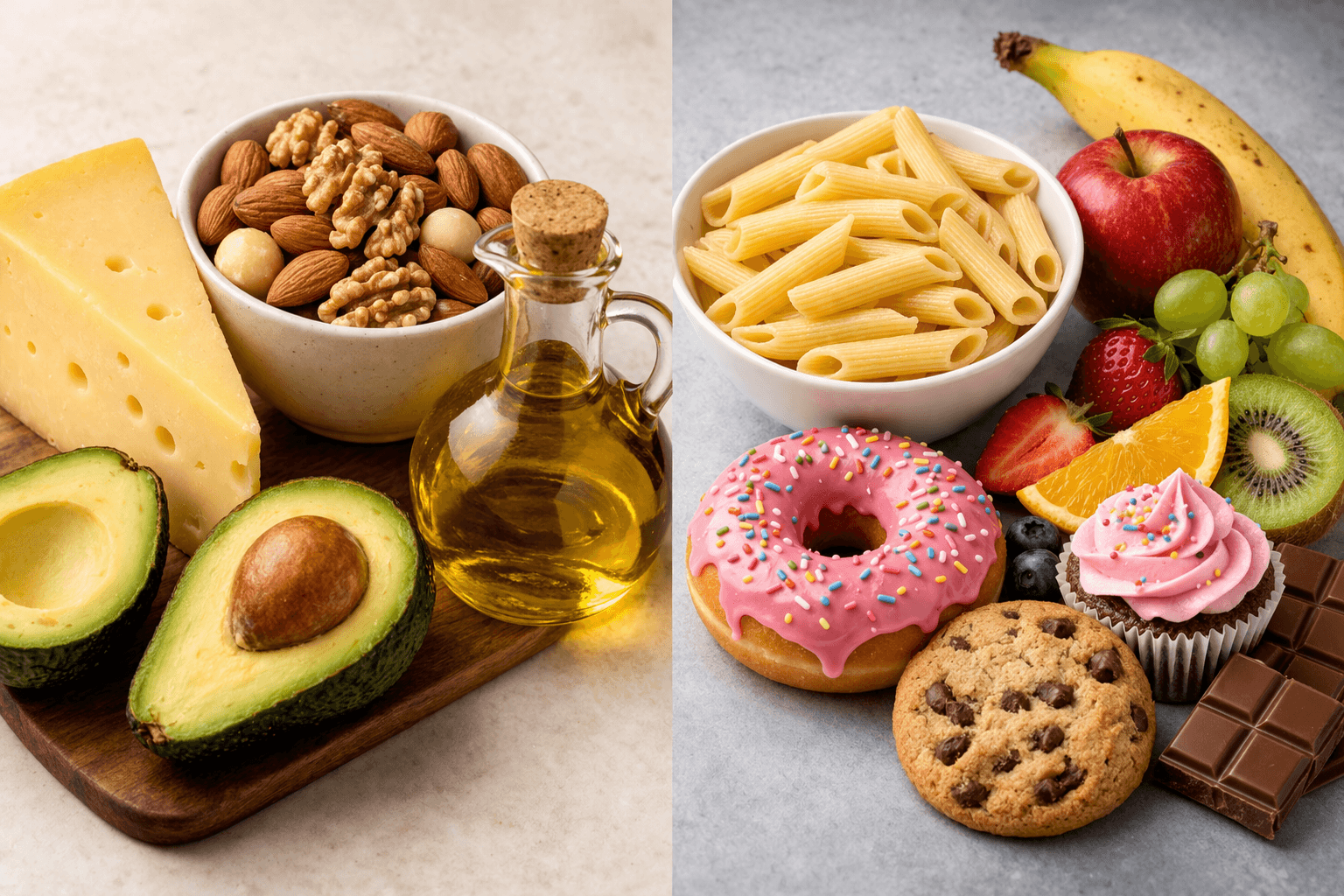
A useful way to think about the debate is this: calories explain most of the outcome, while nutrient handling helps explain some of the mechanism. Fat and carbohydrate are both sources of energy, and both can contribute to weight gain when eaten in excess. However, the body does not process an excess of dietary fat in exactly the same way it processes an excess of carbohydrate.
This matters because people often confuse two different questions. The first is, “What causes body weight to go up over time?” The second is, “How does the body partition and store different fuels in the short term?” The first question is mostly answered by total energy intake relative to expenditure. The second involves oxidation, storage, glycogen dynamics, appetite, food quality, and food environment.
When calories are matched, fat and carbs often produce similar weight outcomes
One reason the fat-versus-carb argument persists is that many people expect one macro to dramatically outperform the other. But in free-living long-term studies, that usually does not happen. The average difference in body weight change between lower-fat and lower-carbohydrate diets tends to be small, especially by 12 months or longer, and outcomes depend heavily on adherence and food quality.
That does not mean the two diets feel the same or work equally well for every individual. Some people find a lower-carb approach easier to follow because it reduces appetite or simplifies food choices. Others do better on a lower-fat pattern because it allows higher food volume and more dietary flexibility. But at the population level, the evidence does not support the claim that carbohydrate is uniquely fattening when calories are held constant.
Overeating studies show an important difference: dietary fat is stored more efficiently
Where fat and carbohydrate do differ is in short-term overfeeding physiology. In a classic controlled overfeeding study, participants consumed about 50% above energy requirements for 14 days. Carbohydrate overfeeding increased carbohydrate oxidation and total energy expenditure over time, with roughly 75–85% of the excess energy ending up stored. Fat overfeeding, by contrast, had minimal effects on fat oxidation and energy expenditure, and about 90–95% of the excess energy was stored.
This is the strongest evidence behind the statement that dietary fat is stored more efficiently in a surplus. The body has a more limited immediate capacity to store carbohydrate because glycogen stores are finite and carbohydrate oxidation rises when carbohydrate intake rises. Dietary fat, on the other hand, can be deposited into adipose tissue relatively easily, especially when total energy intake is high.
So, if two surpluses are matched calorie for calorie, the surplus from fat is generally stored a little more directly. That does not make carbohydrate harmless, but it does mean the simplistic line “carbs are more fattening” does not fit the physiology very well.
The carbohydrate-insulin hypothesis is influential, but not well supported as a full explanation of obesity
The carbohydrate-insulin model argues that high-carbohydrate diets, especially high-glycemic-load diets, drive fat storage by increasing insulin secretion, which then redirects energy into adipose tissue and promotes hunger. This idea has been very influential in public nutrition debates.
However, controlled feeding studies have not convincingly shown that carbohydrate has a unique fattening effect independent of calories. A metabolic ward study by Hall and colleagues found that, calorie for calorie, restricting dietary fat led to slightly more body-fat loss than restricting carbohydrate over six days in people with obesity, which is the opposite of what a strong version of the carbohydrate-insulin hypothesis would predict.
A fair summary is that insulin certainly matters in metabolism, but obesity cannot be reduced to “carbs raise insulin, therefore carbs are the cause of fat gain.” Fat can be stored without dietary carbohydrate, insulin responses vary by overall meal composition and metabolic status, and long-term body weight is shaped by many interacting factors including energy intake, food processing, satiety, food reward, and adherence.
Carb quality matters more than carb quantity alone
One of the most useful findings in recent nutrition research is that the type of carbohydrate matters more than simply total carbohydrate. A 2023 BMJ analysis found that increases in starch intake and added sugar were associated with greater weight gain over time, while replacing refined grains or starchy vegetables with whole grains, fruit, or non-starchy vegetables was associated with less weight gain. The starch signal was stronger than the added sugar signal in that analysis.
This helps explain why “carbs” as a single category can be misleading. Lentils, oats, berries, white bread, sweets, sugary drinks, and pastries are all carbohydrate-rich foods, but they differ dramatically in fibre, water content, texture, satiety, energy density, speed of eating, and effects on total calorie intake. The same is true for fats: nuts, avocado, olive oil, deep-fried fast food, and pastries all contain fat, but they are not nutritionally equivalent.
For long-term weight management, refined grains, ultra-processed starches, sugar-sweetened beverages, and hyper-palatable fat-plus-carb foods appear to be more problematic than whole grains, fruit, legumes, and non-starchy vegetables.
Why low-carb diets often cause fast early weight loss
Many people try a low-carb diet and notice rapid weight loss in the first week or two. That experience is real, but it is often misunderstood. Restricting carbohydrate lowers glycogen stores, and each gram of glycogen is stored with roughly 3 grams of water. As glycogen falls, associated water is lost too, which can lead to a quick drop on the scale even before substantial body-fat loss has occurred.
This is one reason short-term diet comparisons can be misleading. A fast change in body weight does not always mean a fast change in body fat. Once carbohydrate intake rises again, glycogen and water stores can replenish, and part of that early loss can reverse.
That does not mean low-carb diets never reduce body fat. They can, especially when they help someone eat fewer calories overall. It simply means that early scale changes should not automatically be interpreted as superior fat loss.
Real life matters more than metabolic theory
In the real world, people do not overeat pure carbohydrate or pure fat. They overeat foods. And the foods most associated with passive overconsumption are often combinations of fat and refined carbohydrate: pastries, pizza, ice cream, chocolate, fries, chips, and many fast foods. These foods are highly palatable, energy dense, easy to eat quickly, and often low in fibre and protein relative to their calorie load.
This is why arguing about macros in isolation can miss the bigger picture. A person is far more likely to gain weight from a diet full of ultra-processed, easy-to-overeat foods than from a diet centered on minimally processed foods, even if both diets contain carbohydrate and fat. Food quality changes how much people naturally eat, how full they feel, and how sustainable the diet is over time.
So, are fat or carbs more fattening?
The most accurate answer is this:
Total calories are the dominant driver of weight gain. When calories are matched, fat and carbohydrate tend to produce similar long-term weight outcomes on average. But in short-term overfeeding, dietary fat is stored a bit more efficiently than carbohydrate. Meanwhile, carbohydrate quality matters enormously: refined, low-fibre, ultra-processed carbohydrate sources are more strongly linked with weight gain than whole-food carbohydrate sources.
So the practical answer is not “avoid all carbs” or “fat is the only problem.” It is:
Choose mostly whole, minimally processed foods.
Watch total calorie intake over time.
Pay attention to foods that are easy to overeat.
Do not confuse early water loss with fat loss.
Focus on the quality of carbs and fats, not just the quantity.
If you would like support with achieving your healthy weight without restriction, Book a consultation with me.
Testing can be arranged where appropriate, and recommendations are always evidence-based and individualised.
References
Gardner, C.D. et al. (2018) ‘Effect of low-fat vs low-carbohydrate diet on 12-month weight loss in overweight adults and the association with genotype pattern or insulin secretion: the DIETFITS randomised clinical trial’, JAMA, 319(7), pp. 667–679. Available at: JAMA.
Hall, K.D. et al. (2015) ‘Calorie for calorie, dietary fat restriction results in more body fat loss than carbohydrate restriction in people with obesity’, Cell Metabolism, 22(3), pp. 427–436. Available at: Cell Metabolism
Hall, K.D. et al. (2019) ‘Ultra-processed diets cause excess calorie intake and weight gain: an inpatient randomised controlled trial of ad libitum food intake’, Cell Metabolism, 30(1), pp. 67–77.e3. Available at: Cell Metabolism.
Horton, T.J. et al. (1995) ‘Fat and carbohydrate overfeeding in humans: different effects on energy storage’, The American Journal of Clinical Nutrition, 62(1), pp. 19–29. Available at: The American Journal of Clinical Nutrition
Howell, S. and Kones, R. (2017) ‘“Calories in, calories out” and macronutrient intake: the hope, hype, and science of calories’, American Journal of Physiology-Endocrinology and Metabolism, 313(5), pp. E608–E612. Available at: AJP-Endocrinology and Metabolism
Wan, Y. et al. (2023) ‘Association between changes in carbohydrate intake and long term weight changes: prospective cohort study’, BMJ, 382, e073939. Available at: BMJ.
Blogs and Insights