💕 Skin & Aging
anti-aging
beauty
August 27, 2025
Share
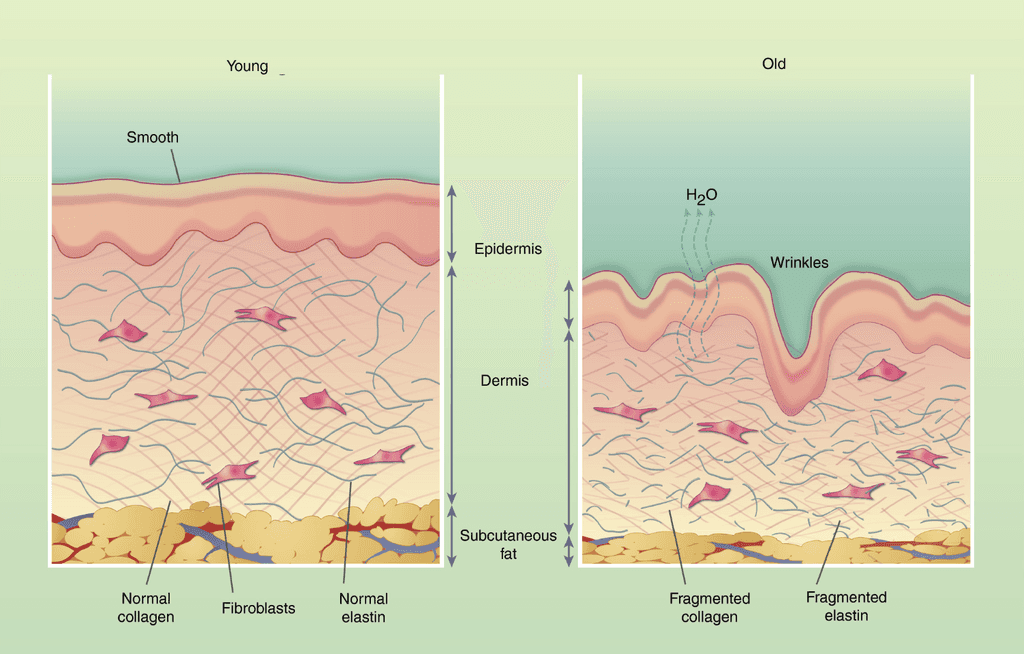
(Chambers and Vukmanovic-Stejic, 2019)
What are AGEs?
Advanced glycation end products (AGEs) are chemically diverse compounds formed by non‑enzymatic reactions between reducing sugars and proteins, lipids or DNA (the Maillard reaction). The process begins with rapid formation of a Schiff base and Amadori products; over weeks to months these rearrange into stable AGEs .
Skin proteins such as collagen and elastin turn over slowly, making them prone to accumulating AGEs . Glycative stress is accelerated by high blood glucose, oxidative stress, UV radiation and pollution .
Glycation leads to inter‑ and intra‑molecular cross‑links in collagen. These cross‑links stiffen collagen fibres, decrease flexibility and impair the ability to remodel collagen . Glycation also modifies elastin, causing the fibres to assemble irregularly, lose elasticity and become resistant to degradation . The result is reduced skin elasticity and increased stiffness in vivo .
AGEs bind to the receptor RAGE, triggering inflammatory signalling (NF‑κB), oxidative stress and increased matrix metalloproteinases. In skin cells this decreases fibroblast and keratinocyte proliferation, increases apoptosis and senescence, reduces extracellular matrix (ECM) synthesis and increases ROS production .
Accumulation of AGEs in the dermis contributes to visible signs of aging such as wrinkles, loss of elasticity, dullness and sallowness . AGEs slow wound healing and reduce skin barrier lipids.
Rosmarinic Acid and Rosemary Extract: Mechanisms Against AGEs
Rosmarinic acid (RA) is a caffeic‑acid derivative found in rosemary, lemon balm and other Lamiaceae herbs. It has potent antioxidant and anti‑inflammatory properties. Research has identified several anti‑glycation mechanisms:
Prevention of AGE formation – RA reduces reactive carbonyl intermediates in the glycation pathway, decreases protein carbonylation and scavenges dicarbonyls . In vitro studies show RA and rosemary extract inhibit ribose‑induced AGE formation in collagen and elastin .
RAGE signalling – RA reduces oxidative stress and blocks RAGE activation, thereby lowering downstream inflammatory signalling and matrix degradation .
Deglycation (“AGE‑breaking”) – RA can destabilize existing AGE cross‑links. An in‑vitro HPLC study reported RA reversed 53 % of protein cross‑links versus control (p < 0.0001), outperforming aminoguanidine and alagebrium . Rosemary extract with its natural cofactors exhibited ~2.4‑fold greater deglycation ability than pure RA.
Human Trials Evaluating Rosmarinic Acid and Rosemary Extract
Intervention & study | Participants | Key findings |
|---|---|---|
BioR dietary supplement (300 mg rosemary extract plus biotin and zinc) | Double‑blind RCT in 104 women (40–65 y) for 12 weeks | Compared with placebo, BioR significantly improved skin dullness (p=0.04), roughness/texture (p=0.001), erythema (p=0.05) and pore size (p=0.04) at week 12 and improved global skin quality at weeks 8 and 12 . The supplement was well tolerated; one subject discontinued because of gastrointestinal upset . |
BioR biomarker subset | Subset of 32 subjects from above trial with skin biopsies and tape‑strips | After 12 weeks, BioR significantly reduced 4‑hydroxynonenal (4HNE) protein adducts and AGE levels in skin biopsies compared with placebo (p<0.005) . Tape‑strip samples showed significant reductions in 4HNE from baseline . These findings suggest BioR can reduce oxidative stress and reverse AGE accumulation in human skin . |
Nutroxsun (rosemary + grapefruit polyphenols) | Randomised, parallel‑group trial (90 subjects) with doses of 100 mg or 250 mg for 2 months | Wrinkle depth (crow’s feet) decreased by 8.8 %, 13.4 % and 14.8 % after 0.5, 1 and 2 months in the 100‑mg group (p=0.0000) . Skin gross elasticity increased by 4.6 % after 2 months and net elasticity increased by 9 % at 2 months . There were no significant changes in the placebo group . |
Lemon balm tea (Melissa officinalis) | Open‑label study; 28 healthy Japanese adults drank lemon balm tea or barley tea for 6 weeks | Lemon‑balm tea (rich in RA) reduced forearm skin yellowing (b* value) and improved cheek skin elasticity compared with control . Details such as percentage change and statistical significance were not fully reported. |
Other Human Interventions Targeting AGEs in Skin
Intervention & study | Active component & rationale | Participants | Outcomes |
|---|---|---|---|
Multicomponent nutraceutical (MCN) | Tablets containing hyaluronic acid (200 mg/d), L‑carnosine (500 mg/d) and methylsulfonylmethane (MSM). Carnosine is a dipeptide with strong anti‑glycation/AGE‑breaking activity . | Randomised, single‑blind RCT (50 women aged 40–65) taking two tablets daily for 60 days | MCN increased glabella skin hydration by 15.2 % and elasticity by 22.6 % (p=0.03 and p=0.004), reduced glabella sebum by 24.2 % (p=0.01) and improved hydration/elasticity in periocular (+12.6 %/+15.9 %) and oral commissural (+17.6 %/+16 %) areas . Wrinkle depth improved slightly (p=0.043) . No significant changes occurred with placebo. |
NdCAT gel (novel tryptamine antioxidant) | Gel containing 10 ppm N‑dichloroacetyl tryptamine (NdCAT), a newly synthesised antioxidant that stimulates autophagy and inhibits glycation | Open clinical study; 21 Asian women (mean age ~45) applied gel twice daily for 4 weeks | AGE levels in corneocytes decreased by 55.5 % at 2 weeks and 66.9 % at 4 weeks based on fluorescence intensity . Skin autofluorescence also decreased . Melanin and erythema indices decreased and skin elasticity and hydration increased significantly after 2 and 4 weeks . |
Diet and lifestyle recommendations | AGE formation is exacerbated by high sugar diets and cooking methods that produce exogenous AGEs (frying, grilling). Polyphenol‑rich diets and herbs may inhibit glycation. | (General recommendations) | The BioR study emphasised that diets rich in fruits, vegetables, herbs and low in fried or baked foods can reduce AGE accumulation in skin . |
Summary and Practical Implications
AGE damage in skin results from slow turnover of structural proteins (collagen, elastin), exposure to sugars and oxidative stress. Glycation cross‑links stiffen collagen, impair ECM turnover and activate inflammatory pathways via RAGE , contributing to wrinkles, loss of elasticity and dullness .
Rosmarinic acid (RA) and rosemary extract show multiple anti‑glycation actions: preventing AGE formation, quenching ROS, blocking RAGE signalling and breaking existing AGE cross‑links . RA is synergistic with rosemary cofactors – the proprietary CORExtract showed 2.4‑fold greater deglycation than pure RA .
Clinical evidence supports RA‑rich supplements improving skin appearance and reducing AGEs. The BioR RCT showed significant improvements in skin dullness, texture, erythema and pore size versus placebo after 12 weeks, accompanied by reductions in oxidative stress markers and skin AGEs . Nutroxsun (rosemary + grapefruit) supplementation in healthy adults improved wrinkle depth and elasticity within 2 months . Lemon balm tea also improved skin elasticity in a small open trial .
Other anti‑AGE strategies include supplementation with carnosine (as part of MCN), which improved skin hydration and elasticity in a RCT ; and topical application of NdCAT, which decreased skin AGEs and improved elasticity and hydration over 4 weeks . Diets low in simple sugars and rich in polyphenols may complement these interventions .
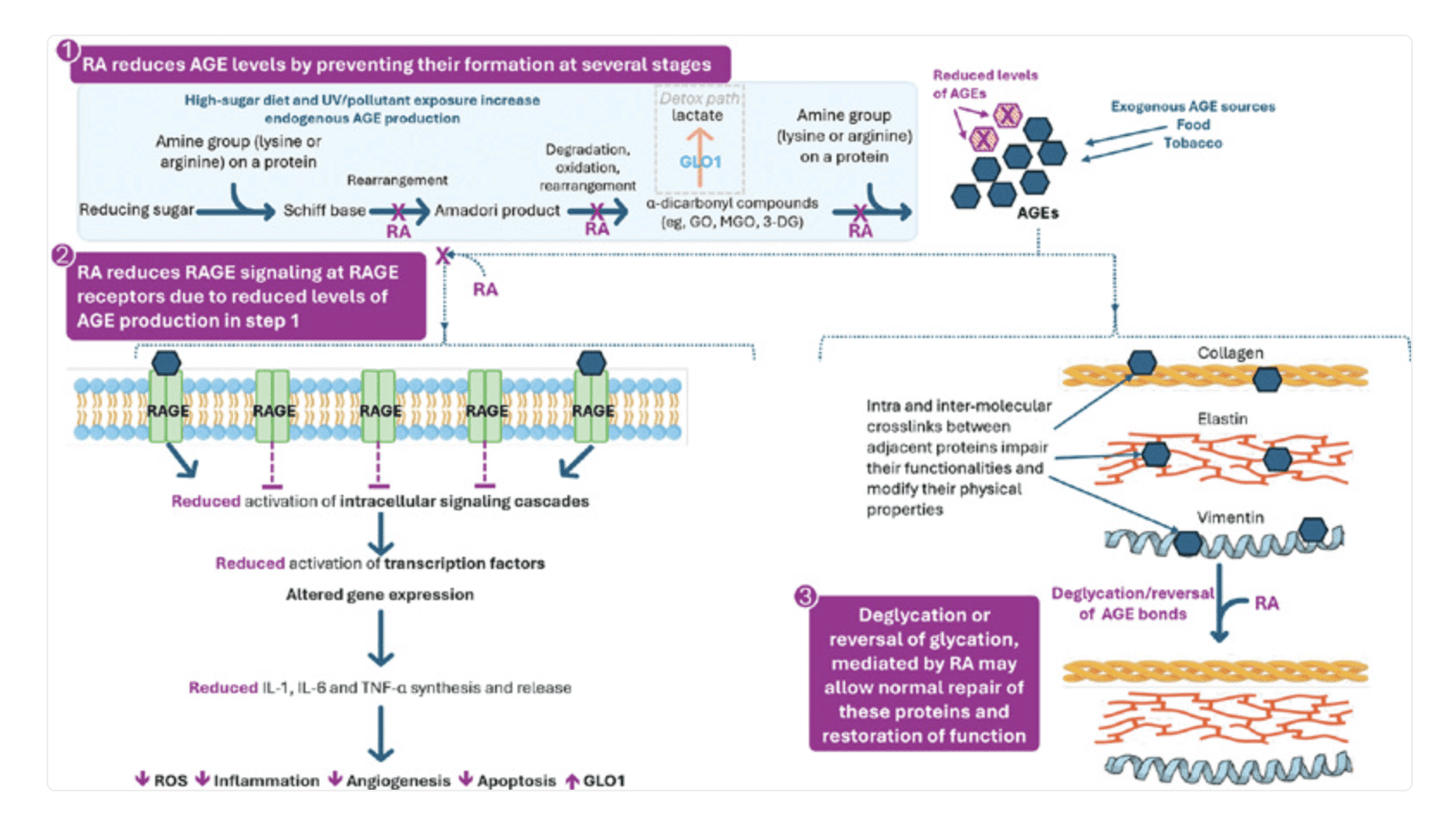
(Draelos et al. 2025)
Key Takeaways
AGEs drive skin aging through collagen cross‑linking, ECM stiffening and inflammatory signalling. Avoiding high‑glucose diets, UV exposure and smoking can limit AGE accumulation.
Rosmarinic acid – a polyphenol from rosemary and lemon balm – is a potent anti‑glycation and antioxidant molecule. It reduces AGE formation and can break existing AGE cross‑links .
Human trials with RA‑rich supplements (BioR and Nutroxsun) demonstrate improvements in skin elasticity, wrinkle depth and reductions in skin AGEs .
Supporting strategies, including carnosine supplementation and innovative antioxidants like NdCAT, also show anti‑AGE benefits in small clinical studies .
Holistic approach – Combining dietary changes (low‑AGE diet), polyphenol‑rich foods, targeted supplements (RA, carnosine) and lifestyle modifications provides a multi‑pronged strategy to minimise AGE‑related skin damage.
Reference List:
Gkogkolou, P. and Böhm, M. (2012) ‘Advanced glycation end products: Key players in skin aging?’, Dermatoendocrinology, 4(3), pp. 259-270. Available at: https://doi.org/10.4161/derm.22028.
Draelos, Z., Bucay, V., Watchmaker, J. and Valacchi, G. (2025) ‘Reversing glycation with a dietary supplement containing rosemary extract’, Journal of Clinical and Aesthetic Dermatology, 18(2), pp. 44-49. Available at: https://pubmed.ncbi.nlm.nih.gov/40136144/.
Draelos, Z.D. et al. (2025) ‘A single-center, double-blinded, randomized, placebo-controlled trial evaluating the safety and efficacy of a dietary supplement containing rosemary extract on visible facial skin quality’, Journal of Clinical and Aesthetic Dermatology, 18(3), pp. 28-33. Available at: https://pubmed.ncbi.nlm.nih.gov/40136148/.
Chambers, E.S. and Vukmanovic-Stejic, M. (2019) ‘Skin barrier immunity and ageing’. Available at: https://doi.org/10.1111/imm.13152.
Nobile, V.A. et al. (2016) ‘Skin photoprotective and antiageing effects of a combination of rosemary (Rosmarinus officinalis) and grapefruit (Citrus paradisi) polyphenols’, Food & Nutrition Research, 60, p. 31871. Available at: https://doi.org/10.3402/fnr.v60.31871.
Guaitolini, E. et al. (2019) ‘Randomized, placebo-controlled study of a nutraceutical based on hyaluronic acid, L-carnosine, and methylsulfonylmethane in facial skin aesthetics and well-being’, Journal of Clinical and Aesthetic Dermatology, 12(4), pp. 40-45. Available at: https://pubmed.ncbi.nlm.nih.gov/31119010/
Shin, K. et al. (2025) ‘Anti-glycation and anti-aging efficacy of newly synthesized antioxidant with autophagy stimulating activity’, Journal of Cosmetic Dermatology, 24(5), p. e70240. Available at: https://doi.org/10.1111/jocd.70240.
Nobile, V. et al. (2016) ‘Skin photoprotective and antiageing effects of a combination of rosemary and grapefruit polyphenols’, Food & Nutrition Research, 60, p. 31871. Available at: https://doi.org/10.3402/fnr.v60.31871.
Yui, S. et al. (2017) ‘Beneficial effects of lemon balm leaf extract on in vitro glycation of proteins, arterial stiffness, and skin elasticity in healthy adults’, Journal of Nutritional Science and Vitaminology, 63(1), pp. 59–64. Available at: https://doi.org/10.3177/jnsv.63.59.
Blogs and Insights