🌸 Hormones & Women’s Health
Biochemistry
Appetite
October 3, 2025
Share

Hormonal Regulation of Appetite and Energy Metabolism
Appetite regulation and energy homeostasis are mediated by an integrated network of peripheral signals from the gastrointestinal tract, adipose tissue, pancreas, gonads, and adrenal glands. These converge at the hypothalamus—particularly the arcuate nucleus—where orexigenic (NPY/AgRP) and anorexigenic (POMC/CART) neurons integrate signals to regulate feeding behaviour, satiety, and energy expenditure.
🔺 Orexigenic Hormones (Promote Feeding)
Ghrelin – Secreted primarily by the gastric fundus, plasma levels rise pre-prandially to stimulate NPY/AgRP neurons, heightening hunger and promoting growth hormone release. Elevated during caloric restriction, ghrelin drives compensatory hyperphagia.
Cortisol (Glucocorticoids) – Produced by the adrenal cortex under HPA-axis activation, cortisol stimulates gluconeogenesis and appetite—especially for energy-dense foods. It also promotes visceral fat deposition. Chronic elevation drives central obesity and metabolic dysfunction.
Glucose-dependent insulinotropic polypeptide (GIP) – Secreted by intestinal K-cells in response to dietary carbohydrates and fats, GIP enhances postprandial insulin release and promotes adipocyte lipogenesis. Dysregulated GIP signalling in obesity contributes to excessive fat storage.
🔻 Anorexigenic Hormones (Suppress Feeding)
Leptin – Produced by adipocytes in proportion to fat mass, leptin suppresses feeding by inhibiting NPY/AgRP neurons and activating POMC/CART neurons, while enhancing energy expenditure. In obesity, leptin resistance disrupts this satiety signal.
Insulin – Secreted by pancreatic β-cells after meals, insulin suppresses appetite via central effects. Insulin resistance blunts this signal and undermines energy balance.
Glucagon-like peptide-1 (GLP-1) – Released from intestinal L-cells post-meal, GLP-1 promotes insulin secretion, suppresses glucagon, slows gastric emptying, and enhances satiety. Its efficacy is diminished in obesity and type 2 diabetes.
Peptide YY (PYY) – Secreted by distal intestinal L-cells after nutrient intake—especially fats and proteins—PYY slows gastric emptying and signals satiety via vagal and central pathways. Circulating levels are reduced in obesity.
Cholecystokinin (CCK) – Released by duodenal I-cells in response to fat and protein, CCK induces digestive enzyme secretion, gallbladder contraction, and satiety via vagal afferents.
Adiponectin – An adipocyte-secreted hormone more abundant in lean individuals, adiponectin enhances insulin sensitivity and promotes fatty acid oxidation. Levels fall in obesity, exacerbating metabolic dysfunction.
Oestradiol (Oestrogen) – Secreted primarily by the ovaries (with minor contributions from adipose and adrenal tissues), estradiol suppresses appetite by stimulating POMC/CART neurons and inhibiting NPY/AgRP neurons. It also raises energy expenditure and favours gluteofemoral fat storage. Menopause-related estradiol decline increases visceral fat, lowers energy expenditure, and heightens cardiometabolic risk.
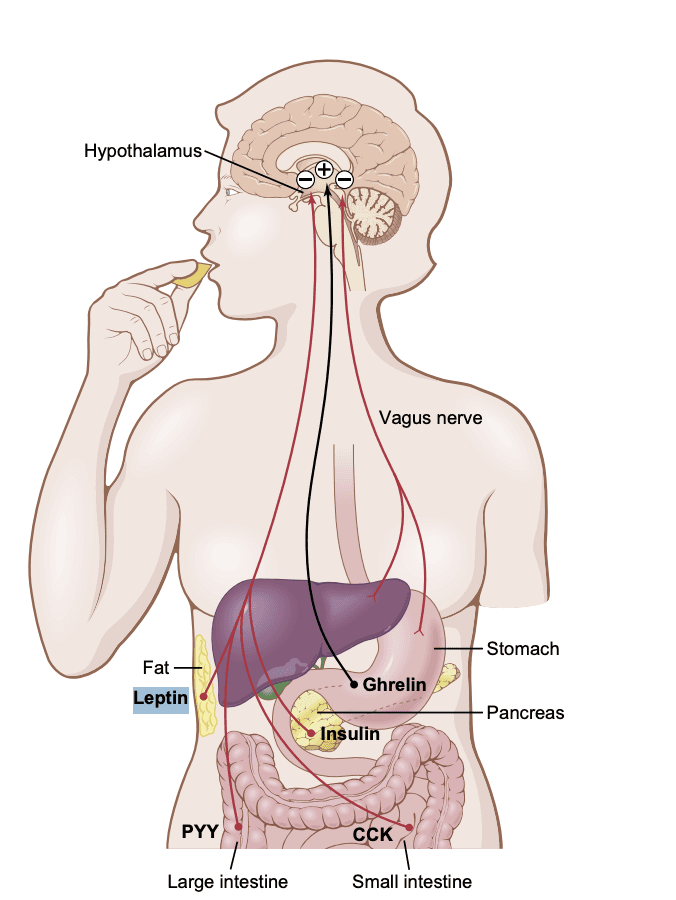
(Hall and Hall , 2021)
Pathophysiological Considerations
Obesity, metabolic syndrome, and type 2 diabetes are characterised by resistance or dysregulation of hormonal signalling rather than absolute deficiency. Leptin and insulin resistance, impaired incretin (GLP-1, PYY) responses, hyperactivity in GIP and cortisol signalling, and oestrogen decline collectively disrupt satiety, elevate hunger, and promote fat accumulation—especially in metabolically harmful visceral depots.
Reference List:
Asarian, L. and Geary, N., 2013. Sex differences in the physiology of eating. American Journal of Physiology-Regulatory, Integrative and Comparative Physiology, 305(11), pp.R1215–R1267. Available at: https://doi.org/10.1152/ajpregu.00446.2012
Batterham, R.L., et al., 2002. Gut hormone PYY3-36 physiologically inhibits food intake. Nature, 418(6898), pp.650–654. Available at: https://doi.org/10.1038/nature00887
Beglinger, C. and Degen, L., 2004. Gastrointestinal satiety signals in humans—physiologic roles for GLP-1 and CCK and therapeutic perspectives. Physiology & Behavior, 82(1), pp.33–38. Available at: https://doi.org/10.1016/j.physbeh.2004.04.023
Blüher, M., 2019. Obesity: global epidemiology and pathogenesis. Nature Reviews Endocrinology, 15(5), pp.288–298. Available at: https://doi.org/10.1038/s41574-019-0176-8
Dallman, M.F., et al., 2003. Chronic stress and obesity: a new view of “comfort food”. Proceedings of the National Academy of Sciences, 100(20), pp.11696–11701. Available at: https://pubmed.ncbi.nlm.nih.gov/12975524/
Dallman, M.F., et al., 2004. Minireview: glucocorticoids—food intake, abdominal obesity, and wealthy nations in 2004. Endocrinology, 145(6), pp.2633–2638. Available at: https://doi.org/10.1210/en.2004-0037
Friedman, J.M., 2019. Leptin and the endocrine control of energy balance. Nature Metabolism, 1(8), pp.754–764. Available at: https://doi.org/10.1038/s42255-019-0095-y
Holst, J.J., 2007. The physiology of glucagon-like peptide 1. Physiological Reviews, 87(4), pp.1409–1439. Available at: https://doi.org/10.1152/physrev.00034.2006
Hall, J.E. and Hall, M.E., 2021. Guyton and Hall Textbook of Medical Physiology. 14th ed. Philadelphia: Elsevier. Chapter. 72: Dietary Balances; Regulation of Feeding; Obesity and Starvation; Vitamins and Minerals.
Holst, J.J., 2007. The physiology of glucagon-like peptide 1. Physiological Reviews, 87(4), pp.1409–1439. Available at: https://doi.org/10.1152/physrev.00034.2006
Kadowaki, T., et al., 2006. Adiponectin and adiponectin receptors in insulin resistance, diabetes, and the metabolic syndrome. Journal of Clinical Investigation, 116(7), pp.1784–1792. Available at: https://doi.org/10.1172/JCI29126
Kojima, M., et al., 1999. Ghrelin is a growth-hormone-releasing acylated peptide from stomach. Nature, 402(6762), pp.656–660. Available at: https://doi.org/10.1038/45230
Morton, G.J., et al., 2006. Central nervous system control of food intake and body weight. Nature, 443(7109), pp.289–295. Available at: https://doi.org/10.1038/nature05026
Blogs and Insights