🥦 Nutrition & Nutrients
Foundations of Health
Research
September 20, 2026
Share
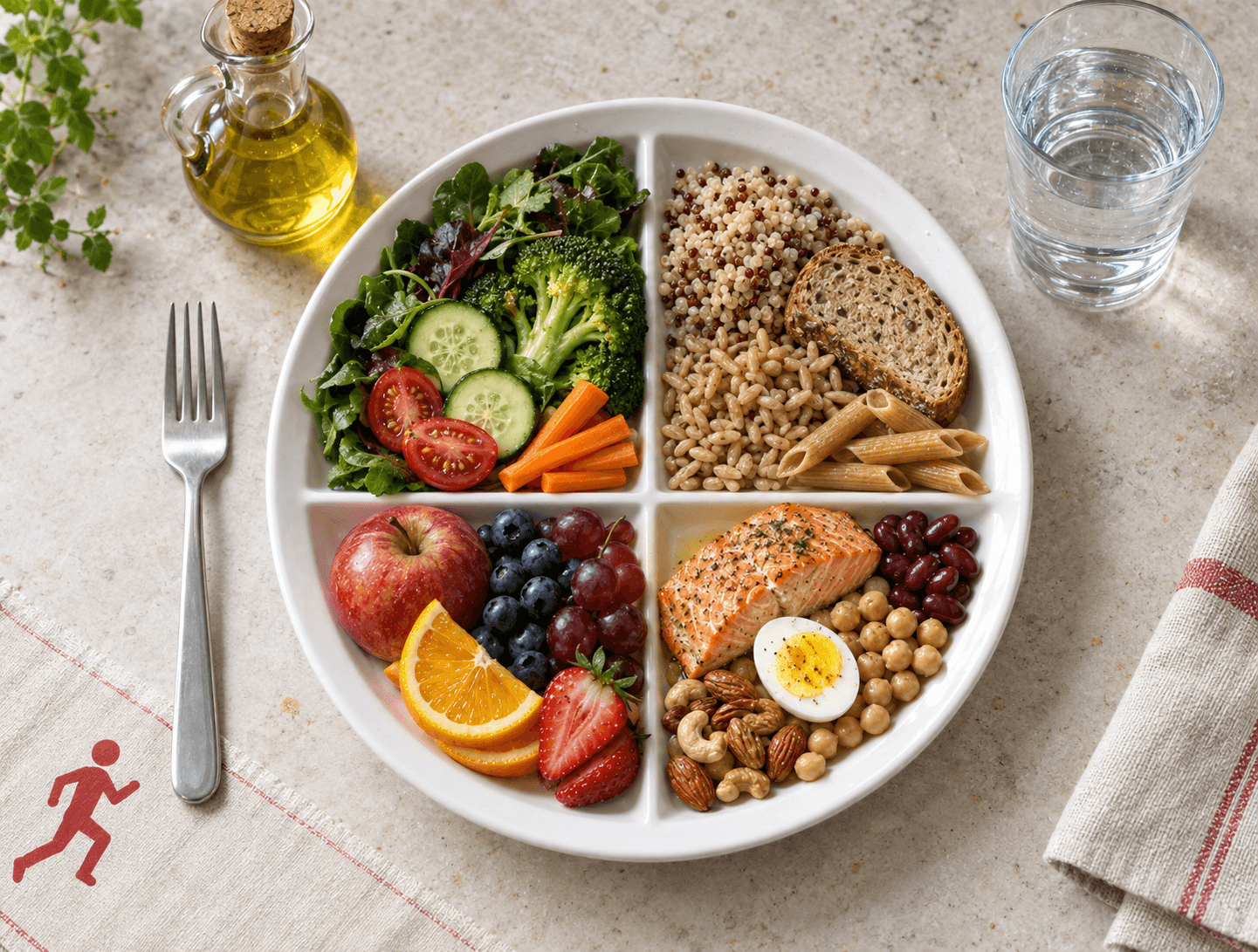
1. Vegetables and fruit: fibre, vitamins, minerals and phytochemicals
Vegetables and fruit should occupy half of the plate, with vegetables forming the larger portion.
They commonly provide:
Fibre, which supports regular digestion, feeds beneficial gut bacteria and helps moderate blood glucose and cholesterol.
Vitamin C, needed for collagen production, wound healing, antioxidant protection and absorption of iron from plant foods.
Vitamin A and carotenoids, which support vision, immunity, growth and normal cell development.
Folate, which is necessary for DNA production and healthy cell division. It is especially important before and during pregnancy.
Potassium, which helps regulate fluid balance, nerve signals, muscle function and blood pressure.
Phytochemicals, including flavonoids and carotenoids, which may help protect cells and influence inflammation.
The health benefit does not come from one “superfood.” Different colours generally represent different combinations of nutrients and plant compounds, which is why variety matters.
In a meta-analysis covering nearly 1.9 million people, eating approximately five daily servings—around two servings of fruit and three of vegetables—was associated with lower total, cardiovascular, cancer and respiratory mortality than eating two servings. This was an observational association, so it cannot prove that fruit and vegetables alone caused the reduction (Wang et al., 2021).
Another large analysis found that every additional 200 grams of fruit and vegetables per day was associated with lower risks of coronary heart disease, stroke, cardiovascular disease and premature death (Aune et al., 2017).
Whole fruit is generally preferable to juice because it retains its fibre and is usually consumed more slowly.
2. Whole grains: complex carbohydrate, fibre and micronutrients
About one quarter of the plate is reserved for whole grains such as oats, barley, quinoa, brown rice and genuinely wholegrain bread.
Whole grains retain the bran, germ and endosperm. Consequently, they generally contain more:
Complex carbohydrate, the body’s principal readily available source of energy.
Fibre, which slows digestion and supports bowel and metabolic health.
B vitamins, which help the body release and use energy from food.
Magnesium, which contributes to muscle and nerve function, glucose regulation and bone health.
Iron, which is required to produce haemoglobin and transport oxygen.
Vitamin E and plant compounds, which have antioxidant and other biological functions.
Refining grain removes much of the bran and germ, reducing its natural fibre and micronutrient content.
A systematic review of more than 1.6 million participants found that each additional 30 grams of whole grains per day was associated with approximately 8% lower cardiovascular-disease risk, 6% lower coronary-heart-disease risk and 6% lower all-cause mortality (Hu et al., 2023).
3. Healthy protein: repair, maintenance and satiety
The remaining quarter of the plate contains protein-rich foods. Protein supplies amino acids that the body uses to:
Build and repair muscles and other tissues.
Produce enzymes, hormones and antibodies.
Maintain skin, hair, organs and the immune system.
Preserve muscle mass, particularly during ageing.
Make meals more satisfying.
However, the source of protein matters because protein foods arrive with different nutritional “packages.”
Beans and lentils
Beans, chickpeas and lentils provide protein together with fibre, slowly digested carbohydrate, folate, potassium, magnesium and iron.
Research associates greater pulse and legume consumption with modestly lower incidence of cardiovascular disease, coronary heart disease, hypertension and obesity, although the certainty of this evidence ranges from low to very low (Viguiliouk et al., 2019).
Nuts and seeds
Nuts and seeds supply protein, fibre, magnesium, vitamin E and predominantly unsaturated fats.
Prospective research associates greater nut consumption with lower cardiovascular-disease incidence and mortality. However, some of the evidence is observational, meaning that other lifestyle differences may contribute to the results (Becerra-Tomás et al., 2019).
Fish
Fish provides complete protein. Oily fish also supplies the omega-3 fatty acids EPA and DHA, while some fish provide vitamin D, iodine and selenium.
Omega-3 fats are important components of cell membranes and have roles in the cardiovascular, nervous and immune systems. Research on omega-3 supplements has produced mixed results, however, and a supplement should not be treated as equivalent to eating fish as part of a balanced dietary pattern. One large review found that marine oils reliably lowered triglycerides, while evidence for preventing major cardiovascular events was less conclusive (Balk et al., 2016).
Poultry and eggs
Poultry and eggs provide complete protein as well as nutrients including vitamin B12, selenium and choline. Vitamin B12 supports red-blood-cell formation and neurological function, while choline is involved in cell membranes and brain and nervous-system activity.
The Harvard model recommends choosing fish, poultry, beans and nuts more often, limiting red meat and minimising processed meats (Harvard T.H. Chan School of Public Health).
4. Healthy fats: essential rather than optional
Fat is sometimes portrayed as something to avoid, but the body needs dietary fat to:
Build cell membranes.
produce hormones and signalling molecules.
Absorb vitamins A, D, E and K.
Support the brain and nervous system.
Supply essential fatty acids that the body cannot manufacture.
The Harvard Plate favours unsaturated fats from foods such as olive oil, nuts, seeds, avocado and fish (Harvard T.H. Chan School of Public Health).
The health effect depends partly on what one food replaces. Replacing saturated fat with refined carbohydrate is unlikely to offer the same benefit as replacing it with nuts, seeds, plant oils, whole grains or other unsaturated-fat sources. Recent trial evidence suggests that replacing saturated fat with polyunsaturated fat may reduce heart attacks among people at high cardiovascular risk, although benefits appear smaller or less certain in low-risk groups (Johnston et al., 2026).
5. Water: essential for almost every bodily system
Water has no calories or vitamins, but it remains an essential nutrient. It is needed to:
Maintain blood volume and circulation.
Regulate body temperature.
transport nutrients and waste.
Support digestion and bowel function.
Lubricate joints and tissues.
Enable normal kidney function.
Replacing sugary drinks with water can also reduce added-sugar and energy intake. Individual water needs vary according to body size, activity, temperature, pregnancy, diet and health.
Why the complete plate matters
A balanced plate works because its components complement one another.
Vitamin C from peppers or broccoli can increase the absorption of plant iron from beans. Fat from olive oil or nuts helps the body absorb fat-soluble compounds from vegetables. Fibre-rich carbohydrate combined with protein and fat usually produces a steadier and more satisfying meal than refined carbohydrate eaten alone.
The plate is therefore more than a collection of individual nutrients. It is a pattern based on:
Predominantly minimally processed foods.
Plenty of varied plant foods.
Whole rather than refined grains.
Nutritious sources of protein.
Mostly unsaturated fats.
Water instead of sugary drinks.
No single meal can prevent disease, and associations found in nutrition studies do not guarantee the same result for every individual. But consistently following this general pattern is associated with better cardiovascular and metabolic health and a lower risk of premature death.
The goal is not dietary perfection. It is to build a varied, nourishing pattern that can be maintained.
References
Aune, D. et al. (2017) ‘Fruit and vegetable intake and the risk of cardiovascular disease, total cancer and all-cause mortality: a systematic review and dose-response meta-analysis of prospective studies’, International Journal of Epidemiology, 46(3), pp. 1029–1056. Available at: https://pubmed.ncbi.nlm.nih.gov/28338764/.
Balk, E.M. et al. (2016) ‘Omega-3 fatty acids and cardiovascular disease: an updated systematic review’, Evidence Report/Technology Assessment, 223, pp. 1–1252. Available at: https://pubmed.ncbi.nlm.nih.gov/30307737/.
Becerra-Tomás, N. et al. (2019) ‘Nut consumption and incidence of cardiovascular diseases and cardiovascular disease mortality: a meta-analysis of prospective cohort studies’, Nutrition Reviews, 77(10), pp. 691–709. Available at: https://pubmed.ncbi.nlm.nih.gov/31361320/.
Harvard T.H. Chan School of Public Health (n.d.) ‘Healthy Eating Plate’. Available at: https://www.hsph.harvard.edu/nutritionsource/healthy-eating-plate/.
Hu, H. et al. (2023) ‘Consumption of whole grains and refined grains and associated risk of cardiovascular disease events and all-cause mortality: a systematic review and dose-response meta-analysis of prospective cohort studies’, American Journal of Clinical Nutrition, 117(1), pp. 149–159. Available at: https://pubmed.ncbi.nlm.nih.gov/36789934/.
Johnston, B.C. et al. (2026) ‘Effect of interventions aimed at reducing or modifying saturated fat intake on cholesterol, mortality, and major cardiovascular events: a risk-stratified systematic review of randomised trials’, Annals of Internal Medicine. Available at: https://pubmed.ncbi.nlm.nih.gov/41397264/.
National Institutes of Health Office of Dietary Supplements ‘Vitamin A and carotenoids: fact sheet for health professionals’. Available at: https://ods.od.nih.gov/factsheets/VitaminA-HealthProfessional/.
National Institutes of Health Office of Dietary Supplements ‘Vitamin C: fact sheet for health professionals’. Available at: https://ods.od.nih.gov/factsheets/VitaminC-HealthProfessional/.
National Institutes of Health Office of Dietary Supplements ‘Potassium: fact sheet for health professionals’. Available at: https://ods.od.nih.gov/factsheets/Potassium-HealthProfessional/.
Viguiliouk, E. et al. (2019) ‘Associations between dietary pulses alone or with other legumes and cardiometabolic disease outcomes: an umbrella review and updated systematic review and meta-analysis of prospective cohort studies’, Advances in Nutrition, 10(Suppl. 4), pp. S308–S319. Available at: https://pubmed.ncbi.nlm.nih.gov/31728500/.
Wang, D.D. et al. (2021) ‘Fruit and vegetable intake and mortality: results from two prospective cohort studies of US men and women and a meta-analysis of 26 cohort studies’, Circulation, 143(17), pp. 1642–1654. Available at: https://pubmed.ncbi.nlm.nih.gov/33641343/.
Blogs and Insights

