⚖️ Weight Loss
Nutrition & Nutrients
Metabolic Health
September 9, 2026
Share

The stomach and intestine communicate with the brain through the vagus nerve and hormones such as ghrelin, GLP-1, peptide YY (PYY) and cholecystokinin (CCK).
Ghrelin generally increases the drive to eat, while GLP-1, PYY and CCK contribute to satiation and satiety. This means that two meals containing the same number of calories can produce very different levels of fullness.
The nutritional goal during weight loss should therefore be to create the greatest possible satiety for the calories consumed.
1. Protein: one of the strongest nutritional tools for satiety
Protein is generally more satiating than an equivalent amount of energy from carbohydrate or fat.
A meta-analysis of randomised controlled trials found that higher-protein meals reduced hunger and desire to eat while increasing fullness. Protein also reduced ghrelin and increased GLP-1 and CCK responses in acute studies (Kohanmoo, Faghih and Akhlaghi, 2020).
Protein therefore affects appetite through several mechanisms:
stimulation of gut satiety hormones
amino-acid sensing
slower digestion compared with many refined carbohydrates
increased diet-induced thermogenesis
preservation of lean mass during weight loss.
For people who resistance train, a large meta-analysis found that gains in fat-free mass tended to plateau at approximately 1.6 g protein/kg/day, with the upper confidence interval around 2.2 g/kg/day (Morton et al., 2018).
During calorie restriction, particularly in lean resistance-trained individuals, higher intakes may be useful. Research in dieting athletes supports approximately 1.8–2.7 g/kg/day, depending on leanness, training load and severity of the calorie deficit (Hector and Phillips, 2018).
Protein should ideally be distributed across meals. Good sources include:
eggs
Greek yogurt and skyr
fish
poultry
lean meat
cottage cheese
tofu and tempeh
legumes.
2. Increase food volume while controlling calories
The stomach contains stretch-sensitive mechanisms that contribute to satiation. As food volume increases, mechanical signals from the gastrointestinal tract help tell the brain that a meal is being consumed. This is why energy density is so important. Energy density describes how many calories are contained in a given weight of food.
For example:
100 g of olive oil: approximately 880 kcal versus 100 g of strawberries: approximately 30 kcal.
Both occupy physical space, but their energy content is dramatically different. Foods rich in water and fibre allow a person to eat a physically larger meal while maintaining a calorie deficit.
Good sources include:
vegetables
whole fruit
potatoes
beans and lentils
soups
low-fat yogurt
lean meat and fish
oats and other grains cooked with water.
A diet composed primarily of these foods allows considerably greater food volume than one dominated by oils, pastries, chocolate, cheese and snack foods.
3. Fibre can improve fullness
Fibre is often presented as one substance, but different fibres behave very differently. Some are highly fermentable, others absorb water, and some form viscous gels within the gastrointestinal tract.
A systematic review found that more viscous fibres, including beta-glucans, pectins and guar gum, were more likely to reduce appetite and acute energy intake than less-viscous fibres (Wanders et al., 2011).
This may occur because viscous fibres can:
increase the volume of gastrointestinal contents
slow nutrient absorption
delay gastric processing
alter gut-hormone signalling.
Good sources include:
oats
barley
beans
lentils
vegetables
berries
apples and pears
whole grains
seeds.
4. Combine protein, fibre and volume
This meal structure is one of the simplest practical approaches to controlling hunger.
For example:
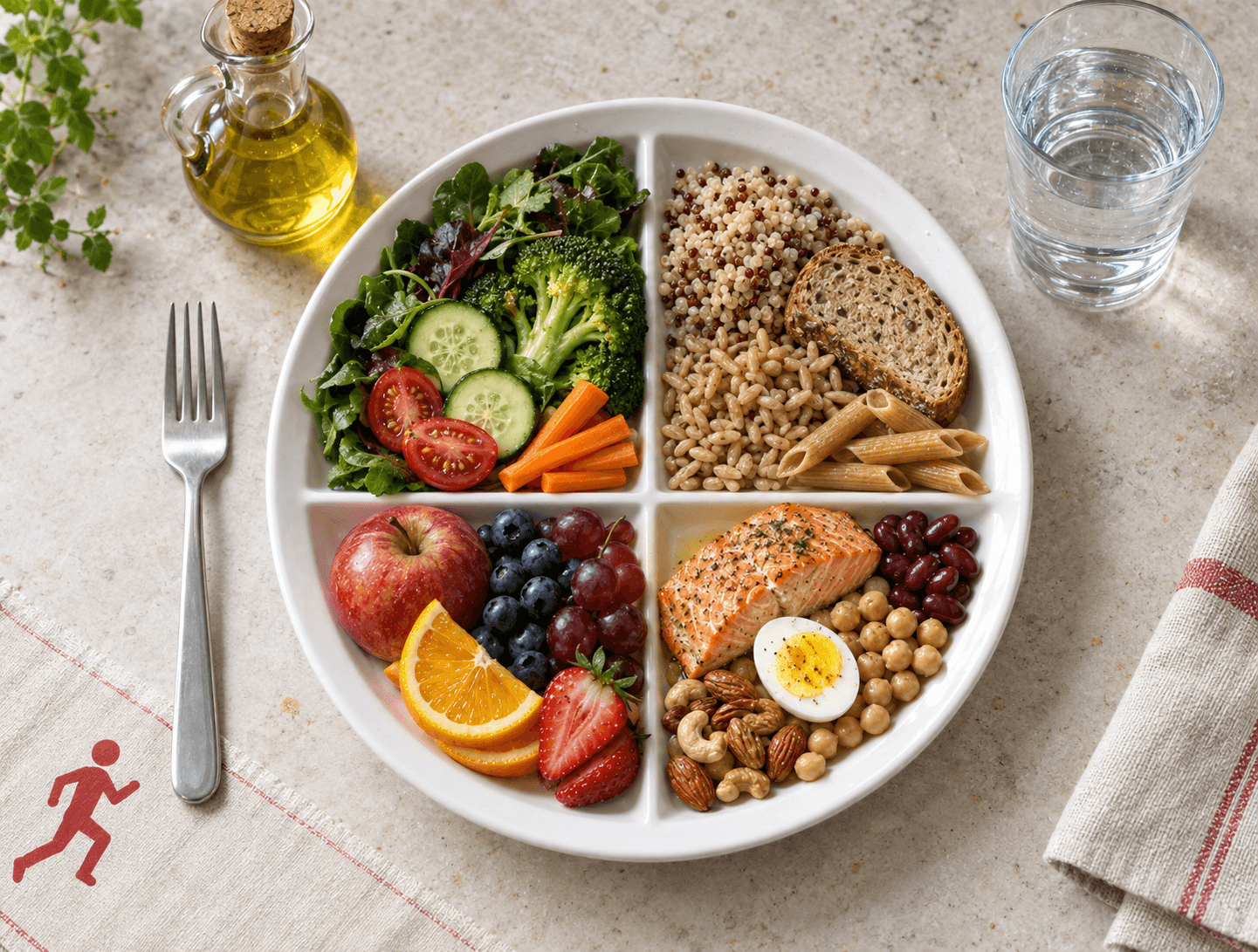
Greek yogurt + berries + oats provides protein, fibre and considerable volume.
Similarly:
Chicken + potatoes + vegetables provides protein, high food volume and relatively low energy density.
Or:
Lentils + vegetables + yogurt combines protein, fibre and water-rich foods.
5. Slow down the speed at which calories are consumed
Satiety signals are not instantaneous. The gastrointestinal tract needs time to respond to:
stomach distension
nutrient arrival in the intestine
secretion of appetite-regulating hormones
neural signals reaching the brain.
Eating very quickly can therefore allow a large number of calories to be consumed before these signals fully influence meal termination.
A systematic review and meta-analysis of 22 experimental studies found that slower eating significantly reduced food intake compared with faster eating (Robinson et al., 2014). Interestingly, participants did not always report dramatically different hunger afterward.
This suggests that eating speed may influence how much food is consumed before stopping, even when subjective hunger does not change greatly.
Foods that naturally encourage slower eating include:
whole fruit
vegetables
meat and fish
beans
intact grains
foods requiring cutting and chewing.
By contrast, soft and highly refined foods can often be consumed very quickly.
6. Ultra-processed foods can make overeating easier
One of the most informative experiments in modern nutrition research was conducted by Hall et al. (2019). Participants lived in a controlled research facility and were given either an ultra-processed or minimally processed diet. They were allowed to eat as much or as little as they wanted. On the ultra-processed diet, participants spontaneously consumed approximately 500 kcal/day more and gained weight. During the minimally processed diet, calorie intake was lower and participants lost weight (Hall et al., 2019).
This does not prove that every processed food causes overeating. Possible explanations include:
faster eating rate
softer texture
higher calorie intake per minute
differences in food structure
greater ease of consumption
differences in protein distribution and energy density.
The practical lesson is not that all processed food must be eliminated. Rather: Foods that allow calories to be consumed extremely quickly can make maintaining a calorie deficit more difficult.
7. Consider calories per minute, not only calories per meal
Traditional dieting focuses almost entirely on calorie content. But eating rate adds another useful concept:
Energy intake rate
Imagine two meals containing 600 kcal. If one is eaten in six minutes 100 kcal/minute If another requires twenty minutes 30 kcal/minute. The second meal gives the body's satiation mechanisms much more time to respond before large amounts of energy have been consumed.
This helps explain why foods such as chocolate, pastries, crisps and some fast foods can be particularly easy to overeat. They combine high energy density + rapid eating speed.
8. Liquid calories can be easy to overlook
Sugary drinks, fruit juice, alcohol, sweetened coffees and high-calorie smoothies can add substantial calories without requiring much chewing.
Liquid calories are not automatically unsatisfying. However, from a practical weight-management perspective, beverages can deliver energy very quickly.
Replacing some calorie-containing drinks with:
water
unsweetened tea
coffee without large amounts of sugar/cream
low-calorie beverages
can leave more of the calorie budget available for filling solid foods.
Protein shakes are different because they can be useful for reaching protein targets, particularly when convenience is important.
9. Carbohydrates are not automatically hunger-producing
A common explanation for hunger is: carbohydrate → insulin → blood-sugar crash → hunger.
This is an oversimplification. Consider the difference between:
lentils
oats
potatoes
fruit
and:
sugary drinks
biscuits
confectionery.
All contain carbohydrate, yet their effects on food volume, fibre, digestion and eating speed are very different. Some carbohydrate-rich foods are actually excellent choices during weight loss.
10. Dietary fat is healthy but calorie-dense
Fat is essential for health and contributes to the absorption of fat-soluble vitamins and production of many biological compounds. It also contributes to satiety signalling. The practical difficulty is that fat provides approximately 9 kcal/g compared with approximately: 4 kcal/g for protein and carbohydrate.
Small quantities can therefore add considerable energy.
For example:
olive oil
butter
mayonnaise
nut butters
cheese
cream
dressings.
A tablespoon or two of oil can add hundreds of calories without substantially increasing the physical size of a meal.
The goal is therefore not to eliminate dietary fat, but to use calorie-dense fats deliberately during weight loss.
11. Avoid excessively aggressive calorie deficits
Hunger naturally tends to increase as calorie restriction becomes more severe. More importantly, weight loss itself produces biological adaptations that encourage weight regain.
Sumithran et al. (2011) showed that after substantial weight loss, changes occurred in several appetite-regulating hormones, including an increase in ghrelin and alterations in leptin, PYY and CCK. Many of these changes remained detectable one year later.
This helps explain why maintaining a lower body weight can become more difficult. The body responds to weight loss by increasing the biological motivation to eat. Consequently, the best calorie deficit is generally not the largest one somebody can tolerate.
12. Sleep affects hunger and energy intake
Although sleep is not a nutrient, it directly affects how easy nutrition becomes.
A meta-analysis of 41 randomised controlled trials found that sleep restriction increased subjective hunger and resulted in an average increase in calorie intake of approximately 253 kcal/day (Zhu et al., 2019). Interestingly, the researchers did not find strong evidence that this was explained simply by changes in ghrelin or leptin.
Sleep deprivation appears to affect appetite through multiple pathways, including:
food reward
cognitive control
fatigue
opportunity to eat
metabolic regulation.
For most adults, maintaining approximately 7–9 hours of adequate-quality sleep can therefore make calorie control easier.
Practical hunger-reduction hierarchy
When someone experiences significant hunger during fat loss, consider the following questions:
1. Is the calorie deficit unnecessarily large?
Extreme restriction usually produces stronger hunger.
2. Is protein intake high enough?
For many resistance-trained adults, approximately 1.6–2.2 g/kg/day is a reasonable evidence-based range.
3. Are meals physically large enough?
Increase vegetables, fruit, potatoes, legumes, soups and other water-rich foods.
4. Is fibre intake adequate?
Prioritise whole-food sources and particularly foods containing viscous fibre.
5. Are calories being consumed too quickly?
Choose foods requiring more chewing and slow the meal down.
6. Are liquid calories consuming too much of the calorie budget?
Consider replacing some with low-calorie beverages.
7. Is the diet dominated by easy-to-eat ultra-processed foods?
Increase minimally processed, structurally substantial foods.
8. Are calorie-dense fats being added without measurement?
Oils, sauces, dressings and nut butters deserve particular attention.
9. Is sleep adequate?
Chronic sleep restriction can make appetite significantly harder to control.
References
Hall, K.D. et al. (2019) ‘Ultra-processed diets cause excess calorie intake and weight gain: An inpatient randomised controlled trial of ad libitum food intake’, Cell Metabolism, 30(1), pp. 67–77.e3. doi:10.1016/j.cmet.2019.05.008.
Hector, A.J. and Phillips, S.M. (2018) ‘Protein recommendations for weight loss in elite athletes: A focus on body composition and performance’, International Journal of Sport Nutrition and Exercise Metabolism.
Kohanmoo, A., Faghih, S. and Akhlaghi, M. (2020) ‘Effect of short- and long-term protein consumption on appetite and appetite-regulating gastrointestinal hormones: A systematic review and meta-analysis of randomised controlled trials’, Physiology & Behavior, 226, 113123. doi:10.1016/j.physbeh.2020.113123.
Morton, R.W. et al. (2018) ‘A systematic review, meta-analysis and meta-regression of the effect of protein supplementation on resistance training-induced gains in muscle mass and strength in healthy adults’, British Journal of Sports Medicine, 52(6), pp. 376–384. doi:10.1136/bjsports-2017-097608.
Robinson, E. et al. (2014) ‘A systematic review and meta-analysis examining the effect of eating rate on energy intake and hunger’, American Journal of Clinical Nutrition, 100(1), pp. 123–151. doi:10.3945/ajcn.113.081745.
Sumithran, P. et al. (2011) ‘Long-term persistence of hormonal adaptations to weight loss’, New England Journal of Medicine, 365(17), pp. 1597–1604. doi:10.1056/NEJMoa1105816.
Wanders, A.J. et al. (2011) ‘Effects of dietary fibre on subjective appetite, energy intake and body weight: A systematic review of randomised controlled trials’, Obesity Reviews, 12(9), pp. 724–739. doi:10.1111/j.1467-789X.2011.00895.x.
Zhu, B. et al. (2019) ‘Effects of sleep restriction on metabolism-related parameters in healthy adults: A comprehensive review and meta-analysis of randomised controlled trials’, Sleep Medicine Reviews. doi:10.1016/j.smrv.2019.02.002.
Blogs and Insights