🥦 Nutrition & Nutrients
Chemistry
pH
October 3, 2025
Share
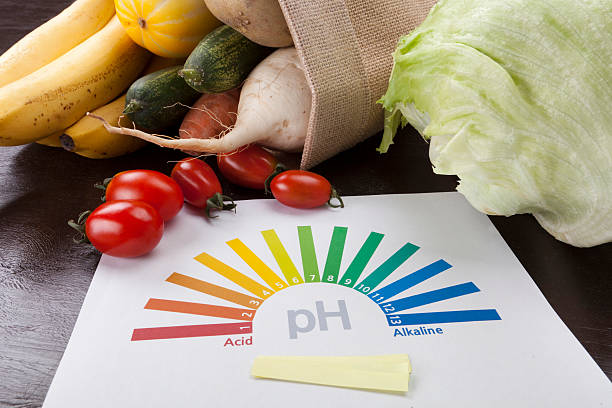
The foods we eat every day exist across a fascinating spectrum of acidity and alkalinity, and understanding this chemistry can unlock important insights about nutrition, digestion, and overall health. The pH of food significantly influences the human body's acid-base balance, which is crucial for maintaining metabolic health and homeostasis. From the sharp tang of a lemon to the subtle alkalinity of egg whites, each food brings its own chemical signature that affects not just taste, but potentially our long-term wellbeing.
What is pH?
In chemistry, pH is a measure of how acidic or basic a solution is, defined as the negative logarithm of its hydrogen ion concentration. The pH scale runs from 0 (most acidic) to 14 (most alkaline), with 7 being neutral (pure water is ~7). Each pH unit represents a tenfold difference in acidity, so a pH of 4 is ten times more acidic than pH 5.
Substances with low pH have high free hydrogen ion levels (high acidity), whereas those with high pH are low in hydrogen ions (basic/alkaline). In the context of foods, pH influences flavor – acids impart sourness – and affects food preservation and microbial growth.
pH of Common Foods
Most natural foods are on the acidic side of the pH scale (below 7.0). Only a few, like egg whites or certain fermenting brines, are mildly alkaline. Here are approximate pH values of common foods:
Food | Approx. pH | Acidity |
|---|---|---|
Lemon juice | ~2.2 | Very acidic |
Cola soft drink | ~2.4 | Very acidic |
Tomato (ripe) | ~4.2 | Acidic |
Black coffee | ~5.1 | Slightly acidic |
Milk | ~6.5 | Mildly acidic |
Spinach | ~6.4 | Mildly acidic |
Egg white | ~7.6 | Slightly alkaline |
Notably, lemon juice and sodas are highly acidic (pH ~2–3), which contributes to their sour taste and can erode tooth enamel with frequent exposure. Milk and vegetables like spinach are near-neutral, and fresh egg white is one of few foods naturally alkaline (around pH 7.6, rising toward 9 as the egg ages).
The Crucial Distinction: Measured pH vs. Metabolic Effects
Here's where nutrition science gets particularly fascinating: the pH of a food itself is not the whole story when it comes to health. Nutritional scientists distinguish a food's measured pH from its acid- or base-forming potential once metabolised. This is because digestion and metabolism can produce acidic or alkaline byproducts that affect the body's internal pH balance.
The Lemon Paradox
Consider the perfect example of lemons: they contain citric acid with a very low pH of around 2, yet when fully metabolised, they yield bicarbonate and other alkaline compounds, making them alkaline-forming in the body. This seeming contradiction illustrates why we can't judge a food's metabolic impact solely by its taste or initial acidity.
Protein and Metabolic Acidity
In contrast, meats and grains have relatively neutral or modest pH as foods, but are rich in proteins and phosphorus that metabolise into acids (like sulfuric and phosphoric acid), making them acid-forming internally. This explains why a non-sour piece of chicken can contribute more to body acidity than a tart lemon.
Measuring Metabolic Impact: PRAL
Researchers quantify this metabolic effect with measures like the Potential Renal Acid Load (PRAL), which estimates the net acid load of a food on the kidneys.
Fruits and vegetables generally have negative PRAL values (net base-producing)
Meats, dairy, and grains have positive PRAL values (net acid-producing)
Dietary Influence on Acid-Base Balance
Foods can be classified as acid-forming or base-forming based on their metabolic byproducts:
Acid-forming foods typically contain high levels of sulfur and phosphorus
Base-forming foods are rich in potassium, calcium, and magnesium
The potential renal acid load (PRAL) of foods helps estimate their impact on systemic pH. A high PRAL indicates a greater acid load, which can challenge the body's buffering systems.
How the Body Maintains pH Balance
The human body maintains a tightly controlled blood pH around 7.35–7.45 – a slightly alkaline range essential for life. Even slight deviations can impair cellular functions, so the body has evolved robust buffering systems:
Primary Regulatory Systems
Bicarbonate buffer system in blood
Protein buffers throughout tissues
Phosphate buffers in cells and urine
Bone mineral reserves - carbonate salts of calcium that can be released to neutralise excess acid
Organ-Based Regulation
Lungs: Remove carbon dioxide (which forms carbonic acid in blood) through breathing
Kidneys: Excrete excess acids or alkalis into urine
These mechanisms ensure that what we eat or drink has only a limited effect on blood pH. For example, consuming a large protein meal might temporarily make the urine more acidic a few hours later, or a veggie-rich meal might make urine more alkaline, but blood pH remains in its narrow safe range.
Health Implications of Dietary pH Patterns
While the body's regulatory systems are remarkably effective, chronic dietary patterns can still influence health outcomes:
Potential Concerns with High Acid Load
Metabolic acidosis, often resulting from a diet consistently high in acid-forming foods, has been linked to:
Bone health issues: Over time, a high dietary acid load may draw on bone mineral reserves, contributing to calcium loss
Kidney stone formation: Increased acid excretion can affect mineral crystallisation
Increased disease susceptibility: Some research suggests chronic low-grade acidosis may contribute to inflammation
Benefits of Base-Forming Foods
A diet rich in base-forming foods (primarily fruits and vegetables) may promote:
Better bone health through reduced mineral mobilisation
Improved gut flora balance
Reduced risk of chronic diseases
Visualising pH Throughout the Human Body
Understanding pH in the context of human health becomes much clearer when we see how dramatically pH varies throughout different body systems. The diagram below illustrates the remarkable pH diversity within our bodies:
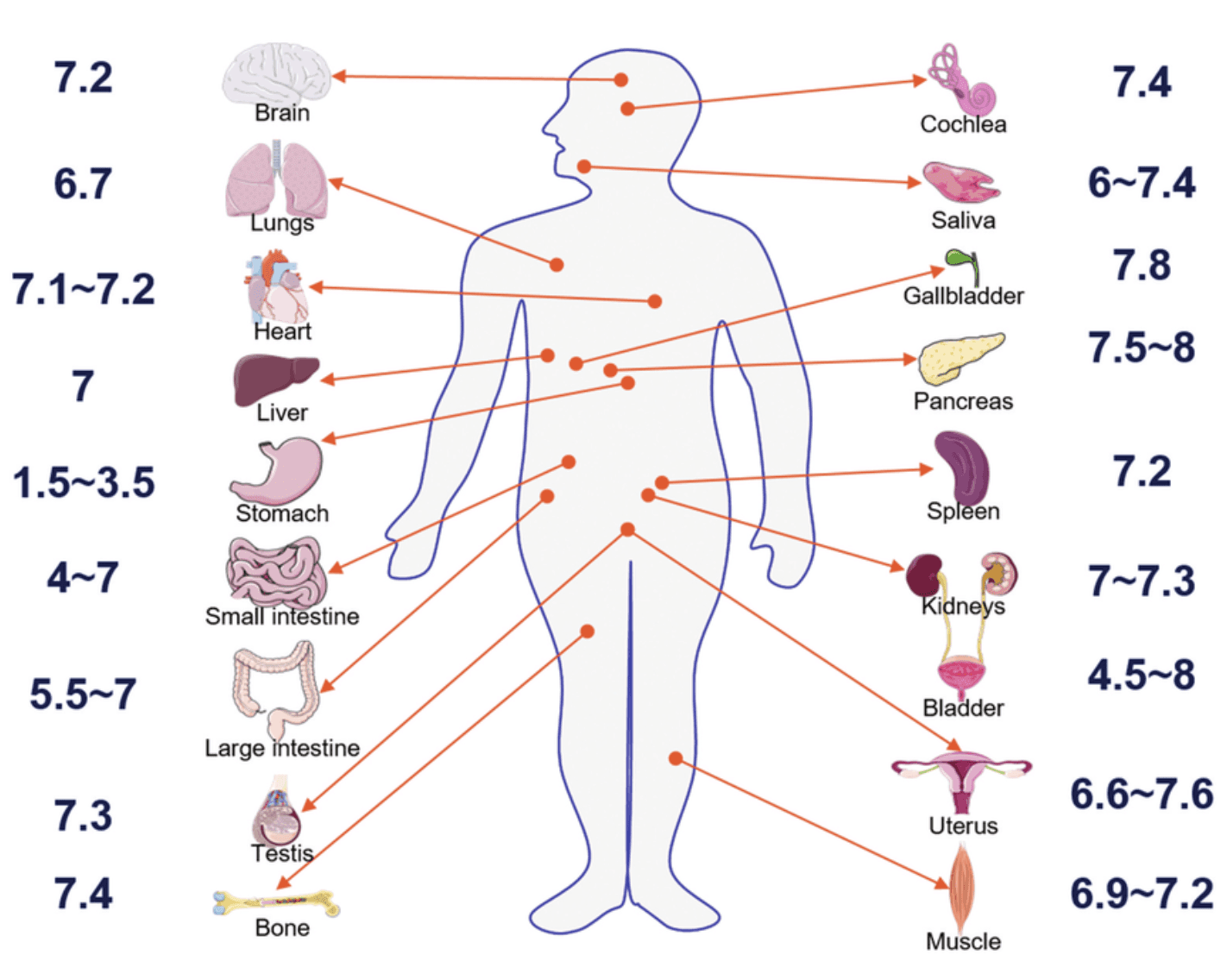
(Gaohua, Miao and Dou, 2021)
As this diagram shows, our bodies maintain vastly different pH environments, each precisely tuned for specific biological functions. The stomach's extremely acidic environment (pH 1.5-3.5) contrasts sharply with the alkaline conditions in the small intestine (pH 7.0-8.5), while blood pH remains tightly controlled within a narrow range (7.35-7.45) that's essential for life.
pH and the Gut Microbiome
Dietary pH factors significantly influence the gut microbiome – the trillions of bacteria in our digestive tract. Different microbes thrive at different pH levels throughout the digestive system:
The Digestive pH Journey
Stomach: Extremely acidic (pH ~1.5–3.5) to sterilise food and aid protein digestion
Small intestine: Becomes slightly alkaline due to bile and pancreatic fluids
Colon: pH varies by region, typically 5.5–6.5 in healthy individuals
Fiber's Role in Colonic pH
In a healthy colon, fermentation of fibres by beneficial bacteria produces short-chain fatty acids (SCFAs) like acetate and butyrate, which lower the local pH to about 5.5–6.5. This modest acidity:
Favours beneficial microbes such as Bifidobacterium
Inhibits potentially harmful bacteria
Supports digestive health and immune function
Conversely, diets low in fibre and high in protein or fat can result in fewer SCFAs and more proteolytic fermentation, releasing alkaline compounds like ammonia that raise colonic pH and may shift the microbial community toward less favourable species.
Practical Applications for Optimal Health
Understanding food pH and its metabolic effects can inform smarter dietary choices:
Focus on Net Effects, Not Just Taste
Don't avoid citrus fruits because they're acidic – they're actually alkaline-forming
Be mindful that even non-sour foods like meat and grains are acid-forming
Include plenty of fruits and vegetables for their base-forming potential
Support Your Microbiome
Choose fibre-rich foods to promote beneficial SCFA production
Include diverse plant foods to maintain healthy colonic pH
Consider fermented foods that support microbial diversity
Balance is Key
While some wellness trends promote strictly alkaline diets, remember that the body's regulatory systems are designed to handle varied inputs. Focus on overall dietary patterns rather than obsessing over individual food pH values.
Body pH Regulation and Food
The human body tightly regulates its internal pH, especially in the blood, to maintain homeostasis. Dietary food pH (acidic or alkaline) does not significantly alter blood or systemic pH in healthy individuals. The body's buffering systems and organs (like kidneys and lungs) quickly neutralize any minor changes caused by food intake, making the concept of "acidifying" or "alkalizing" the body through diet largely unsupported by scientific evidence. Only in rare, severe medical conditions does body pH become imbalanced, and this cannot be corrected by diet alone.
Local Effects in the Digestive Tract
While food pH does not change systemic pH, it can affect the local environment in the gastrointestinal (GI) tract:
Stomach: Food can temporarily raise or lower gastric pH, influencing digestion and nutrient release. For example, high-calorie meals can buffer stomach acid, raising pH for a period after eating.
Intestines: The pH in different GI segments is affected by food, which can impact the absorption of nutrients and drugs.
References
Batool, Z. et al. (2023) ‘Regulation of physiological pH and consumption of potential food ingredients for maintaining homeostasis and metabolic function: An overview’, Food Reviews International, 39(8), pp. 5087–5103. Available at: https://doi.org/10.1080/87559129.2022.2062379.
Demigné, C. et al. (2004) ‘Organic anions and potassium salts in nutrition and metabolism’, Nutrition Research Reviews, 17(2), pp. 249–258. Available at: https://doi.org/10.1079/NRR200485.
Gaohua, L., Miao, X. and Dou, L., 2021. Crosstalk of physiological pH and chemical pKa under the umbrella of physiologically based pharmacokinetic modeling of drug absorption, distribution, metabolism, excretion, and toxicity. Expert Opinion on Drug Metabolism & Toxicology, 17(2), pp.147–162. Taylor & Francis. Available at: https://doi.org/10.1080/17425255.2021.1951223.
Frassetto, L. et al. (2001) ‘Diet, evolution and aging’, European Journal of Nutrition, 40(5), pp. 200–213. Available at: https://doi.org/10.1007/s394-001-8347-4.
Frassetto, L. et al. (2018) ‘Acid Balance, Dietary Acid Load, and Bone Effects—A Controversial Subject’, Nutrients, 10(4), p. 517. Available at: https://doi.org/10.3390/nu10040517.
Frassetto, L., Remer, T. and Banerjee, T. (2022) ‘Dietary Contributions to Metabolic Acidosis’, Advances in Chronic Kidney Disease, 29(4), pp. 373–380. Available at: https://doi.org/10.1053/j.ackd.2022.03.008.
Pizzorno, J. (2015) ‘Acidosis: An Old Idea Validated by New Research’, Integrative Medicine, 14(1).
Remer, T., Dimitriou, T. and Manz, F. (2003) ‘Dietary potential renal acid load and renal net acid excretion in healthy, free-living children and adolescents12’, The American Journal of Clinical Nutrition, 77(5), pp. 1255–1260. Available at: https://doi.org/10.1093/ajcn/77.5.1255.
Remer, T. and Manz, F. (1995) ‘Potential Renal Acid Load of Foods and its Influence on Urine pH’, Journal of the American Dietetic Association, 95(7), pp. 791–797. Available at: https://doi.org/10.1016/S0002-8223(95)00219-7.
Reynaud, Y. et al. (2020) ‘Temporal changes in postprandial intragastric pH: Comparing measurement methods, food structure effects, and kinetic modelling’, Food Research International, 128, p. 108784. Available at: https://doi.org/10.1016/j.foodres.2019.108784.
Schwalfenberg, G.K. (2012) ‘The Alkaline Diet: Is There Evidence That an Alkaline pH Diet Benefits Health?’, Journal of Environmental and Public Health, 2012, p. 727630. Available at: https://doi.org/10.1155/2012/727630.
Blogs and Insights