⚖️ Weight Loss
Lifestyle
Metabolism
October 14, 2025
Share
Why the Body Fights Back
For anyone who has ever struggled to lose body fat — or watched the scales stop moving despite rigid discipline — the problem isn’t simply “lack of willpower.” The real obstacle lies in the body’s extraordinary biological ability to defend its fat stores. From a physiological standpoint, every gram of stored fat represents survival currency, and evolution has fine-tuned powerful systems to protect it.
At the start of a diet, weight often falls quickly as glycogen and water are lost. But soon, almost inevitably, a plateau sets in. Even when calories remain low, progress slows — or stops entirely. This isn’t a failure of effort; it’s the result of metabolic adaptation, an intricate suite of hormonal, neural, and biochemical defenses that activate whenever the body senses sustained energy restriction.
Research shows that resting energy expenditure (REE) — the calories we burn just to stay alive — can drop 10–20% below what would be expected from the weight lost alone. Appetite hormones surge, metabolic rate falls, and the brain intensifies hunger signals to restore balance. Remarkably, these changes can persist for over a year after weight loss, explaining why keeping the weight off is even harder than losing it in the first place.
The Anatomy of Energy Expenditure
To understand why fat loss resistance happens, it helps to look at how the body spends its energy.
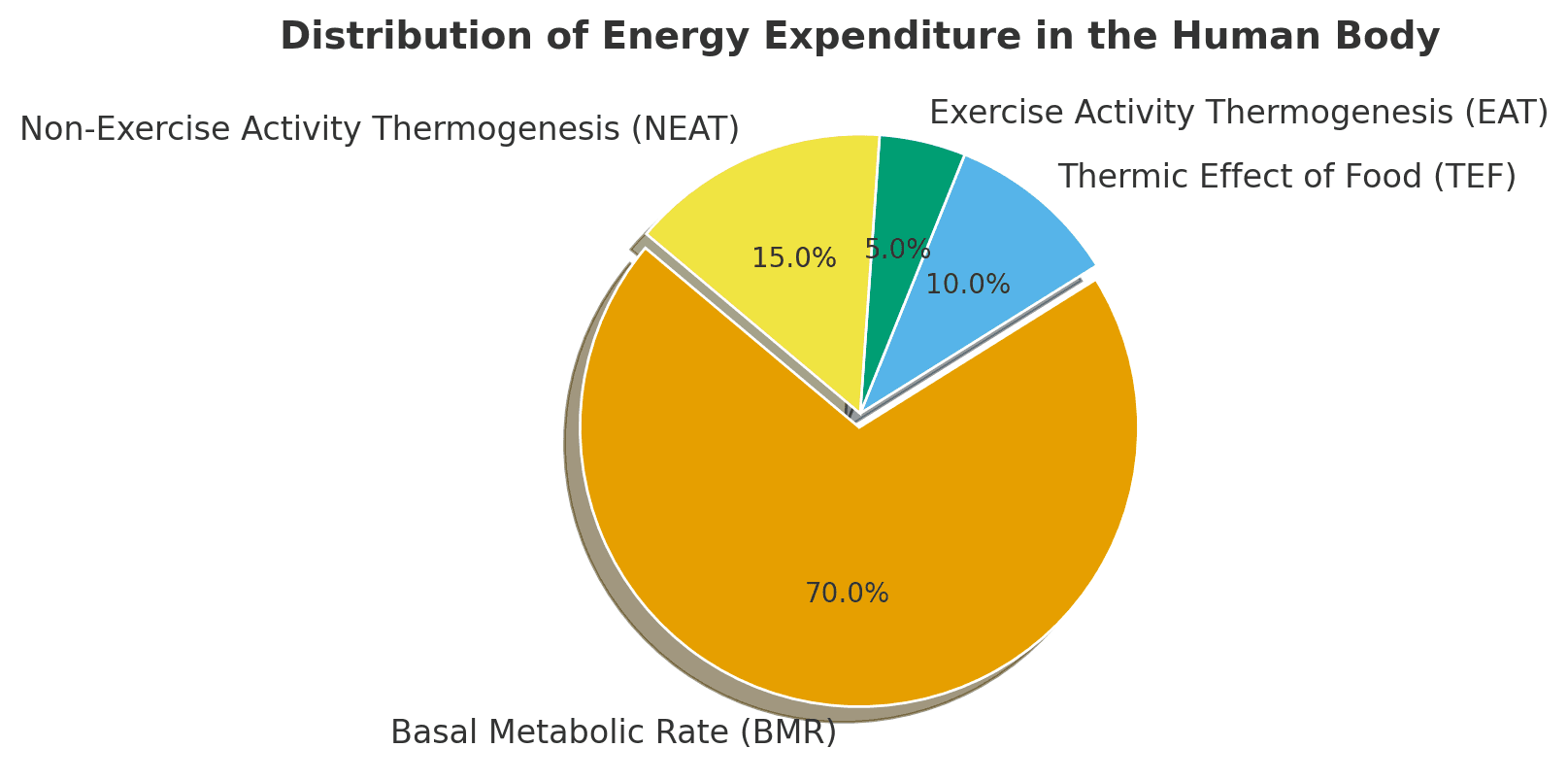
Total Daily Energy Expenditure (TDEE) has four major components:
Basal Metabolic Rate (BMR) — This is the body’s “idling speed,” responsible for 60–75% of daily calorie burn. It powers the invisible processes that keep us alive: heartbeats, breathing, brain activity, liver detoxification, kidney filtration, and cellular repair.
Metabolically, not all tissues are created equal. The brain burns around 240 kcal/kg/day, the liver about 200, and the heart and kidneys roughly 440 — compared to a only 13 kcal/kg/day for muscle and only 4.5 for fat tissue.
This means that even small losses of high-metabolic organs can profoundly lower total metabolism.
Thermic Effect of Food (TEF) — Around 10% of total expenditure comes from the energy required to digest and process nutrients. Protein has the highest thermic cost, which is one reason high-protein diets can subtly boost metabolism.
Exercise Activity Thermogenesis (EAT) — This is the energy burned through intentional physical activity. It’s relatively modest in sedentary people but can double or triple in athletes or highly active individuals.
Non-Exercise Activity Thermogenesis (NEAT) — This includes all the little movements that aren’t formal exercise: standing, walking, fidgeting, housework, even gesturing. NEAT varies widely among individuals and can account for 15–30% of total energy use. During dieting, however, NEAT often drops unconsciously — you fidget less, move slower, and even blink less frequently — further shrinking the calorie deficit.
Adaptive Thermogenesis: The Body’s Energy-Saving Mode
When food intake falls, the body doesn’t passively accept the loss. Falling leptin levels — a hormone released by fat cells — signal to the hypothalamus that energy stores are low. The brain responds by lowering the metabolic thermostat.
This process, called adaptive thermogenesis, can decrease resting metabolism by an additional 100–150 kcal/day on average, and sometimes much more.
Classic studies such as the Minnesota Starvation Experiment showed a 15% metabolic reduction even after accounting for body mass changes. More recent trials confirm that around 40% of the total drop in metabolism during weight loss stems from such adaptive mechanisms, not just tissue loss.
Even more fascinating, high-metabolic organs like the liver, heart, and kidneys physically shrink during weight loss — by about 4–6% in mass — which further reduces the body’s caloric requirements. Combined with small reductions in lean muscle, this organ “downsizing” creates a new, lower metabolic baseline.
The Hormonal Rebellion: Appetite vs. Expenditure
If metabolism is the brake, appetite is the accelerator — and it becomes far more powerful after weight loss.
For every kilogram of weight lost, daily energy expenditure decreases by roughly 20–30 kcal, but hunger increases by about 100 kcal. The imbalance is biologically programmed to drive you to eat back the lost weight.
Leptin, the satiety hormone, plummets as fat stores shrink, making food more rewarding and reducing energy expenditure.
Ghrelin, the hunger hormone, rises sharply, urging you to eat.
Satiety hormones such as GLP-1, PYY, and CCK decline, making it harder to feel full.
The thyroid axis slows, lowering T3 (the active thyroid hormone), and the sympathetic nervous system quiets down, reducing thermogenesis.
Together, these hormonal changes create the classic dieting paradox: the more fat you lose, the harder your body fights to stop you losing more.
Learn more about Hormones in Appetite Regulation & Energy Metabolism
Insulin Resistance and Fat-Storage Bias
Another key factor lies in how efficiently the body handles insulin. Insulin’s job is to shuttle glucose into cells and promote energy storage — including fat storage. But in states of insulin resistance, tissues like muscle become less responsive, while adipose tissue continues to absorb energy efficiently. This creates a biochemical bias toward fat retention.
Chronically elevated insulin levels also suppress lipolysis, the breakdown of stored fat for fuel. This means that even in a calorie deficit, the body struggles to access its fat reserves.
This mechanism is particularly relevant in metabolic syndrome, type 2 diabetes, and polycystic ovary syndrome (PCOS) — conditions marked by high insulin levels and impaired glucose metabolism.
In PCOS, up to 70% of women experience insulin resistance, leading to both elevated insulin and androgen levels. The combination promotes abdominal fat storage and metabolic inflexibility, making fat loss significantly harder. Addressing insulin sensitivity through diet (e.g., lower glycaemic load, higher fiber), exercise, or medical therapies (like metformin) often restores fat-loss potential.
Thyroid Function and the Energy Economy
The thyroid gland acts as the master regulator of metabolism. In hypothyroidism, the production or activation of thyroid hormones (T4 → T3) falls, leading to reduced metabolic rate and lower thermogenesis.
While the actual fat gain in hypothyroidism is modest (often 2–5 kg, much of it fluid), untreated thyroid dysfunction can slow or stall fat loss. Conversely, once thyroid function is corrected, weight-loss capacity returns to normal.
Even without clinical hypothyroidism, prolonged dieting can suppress thyroid conversion and raise reverse T3, effectively creating a “pseudo-hypothyroid” metabolic state.
The Genetic and Evolutionary Set-Point
Some people’s bodies simply defend a higher body-fat “set point.” This set-point is largely determined by genetic and hypothalamic factors that regulate appetite, thermogenesis, and energy partitioning.
When weight drops below this threshold, the body reacts as if it were starving — ramping up hunger and down-regulating metabolism to restore its preferred range. This explains why some individuals regain weight easily, while others maintain loss with less effort.
Twin and adoption studies estimate that 40–70% of body-weight variance is genetic, but epigenetic and environmental influences — such as early nutrition or chronic stress — can modify this metabolic blueprint.
The Gut Microbiome: The New Frontier
Emerging research highlights the gut microbiome as a subtle yet powerful regulator of body weight. Certain bacterial populations can extract more calories from food, while others influence appetite and inflammation via metabolites such as short-chain fatty acids (SCFAs).
Studies show that people who fail to lose weight during lifestyle interventions often harbor gut microbiota optimized for energy extraction and storage — a so-called “obesogenic” microbiome. Though causal evidence is still evolving, microbiome modulation through diet or probiotics may one day become a core component of weight management.
The Influence of Sleep, Stress, and Medication
Fat loss resistance isn’t purely metabolic — lifestyle inputs modulate the hormonal environment.
Sleep deprivation increases ghrelin, decreases leptin, and raises cortisol, all of which boost appetite and reduce glucose tolerance.
Chronic stress maintains high cortisol levels, favouring visceral fat accumulation.
Certain medications (antidepressants, corticosteroids, antipsychotics) can increase appetite or impair metabolic rate, creating biochemical headwinds.
Why the Plateau Persists
The interplay between all these systems — metabolic slowdown, organ shrinkage, hormonal compensation, and behavioural adaptation — creates a new equilibrium where energy intake matches the reduced expenditure. At this “settling point,” weight stabilises even though the person may still be in a caloric deficit compared to their starting level.
Interestingly, recent research suggests that metabolic adaptation alone may not predict weight regain after one or two years; rather, increased appetite and lapses in adherence are the key culprits. But those lapses are themselves biologically driven — the brain’s persistent hunger signalling is the behavioural expression of metabolic defense.
In Summary
Fat loss is not a simple arithmetic of “eat less, move more.” It is a complex biological negotiation between the desire to lose fat and the body’s evolutionary programming to preserve it.
Metabolic rate drops, organs shrink, NEAT decreases, and hunger hormones roar back to life — all conspiring to restore the body’s favoured set point. Overcoming these defenses requires strategies that address both physiology and psychology.
The Good News
The good news is that by working with your unique physiology — not against it — and unpacking your individual underlying causes, it’s absolutely possible to break through the plateau, restore metabolic flexibility.
For more precise, personalised advice Choose a Consultation.
Together we can create a tailored nutrition and lifestyle plan to and achieve both a desirable body composition and optimal health.
References:
Bosy-Westphal, A. et al. (2009) ‘Contribution of individual organ mass loss to weight loss-associated decline in resting energy expenditure’, The American Journal of Clinical Nutrition, 90(4), pp. 993–1001. Available at: https://doi.org/10.3945/ajcn.2008.27402.
Gallagher, D. et al. (2017) ‘Changes in skeletal muscle and organ size after a weight-loss intervention in overweight and obese type 2 diabetic patients’, The American Journal of Clinical Nutrition, 105(1), pp. 78–84. Available at: https://doi.org/10.3945/ajcn.116.139188.
Hall, K.D. and Guo, J. (2017) ‘Obesity Energetics: Body Weight Regulation and the Effects of Diet Composition’, Gastroenterology, 152(7), pp. 1718-1727.e3. Available at: https://doi.org/10.1053/j.gastro.2017.01.052.
Hall, K.D. and Kahan, S. (2018) ‘Maintenance of lost weight and long-term management of obesity’, The Medical Clinics of North America, 102(1), pp. 183–197. Available at: https://doi.org/10.1016/j.mcna.2017.08.012.
Levine, J.A. (2004) ‘Nonexercise activity thermogenesis (NEAT): environment and biology’, American Journal of Physiology – Endocrinology and Metabolism, 286(5), pp. E675–E685. Available at: https://doi.org/10.1152/ajpendo.00562.2003.
Levine, J.A., Schleusner, S.J. and Jensen, M.D. (2000) ‘Energy expenditure of nonexercise activity’, The American Journal of Clinical Nutrition, 72(6), pp. 1451–1454. Available at: https://doi.org/10.1093/ajcn/72.6.1451.
Magkos, F. (2020) ‘On adaptive thermogenesis: just another weight-loss tale?’, The American Journal of Clinical Nutrition, 112(5), pp. 1157–1159. Available at: https://doi.org/10.1093/ajcn/nqaa262.
Martin, A. et al. (2022) ‘Tissue losses and metabolic adaptations both contribute to the reduction in resting metabolic rate following weight loss’, International Journal of Obesity, 46(6), pp. 1168–1175. Available at: https://doi.org/10.1038/s41366-022-01090-7.
Martins, C. et al. (2023) ‘Metabolic adaptation is associated with a greater increase in appetite following weight loss: a longitudinal study’, The American Journal of Clinical Nutrition, 118(6), pp. 1192–1201. Available at: https://doi.org/10.1016/j.ajcnut.2023.10.010.
Müller, M.J. and Bosy-Westphal, A. (2013) ‘Adaptive thermogenesis with weight loss in humans’, Obesity, 21(2), pp. 218–228. Available at: https://doi.org/10.1002/oby.20027.
Polidori, D. et al. (2016) ‘How strongly does appetite counter weight loss? Quantification of the feedback control of human energy intake’, Obesity (Silver Spring, Md.), 24(11), pp. 2289–2295. Available at: https://doi.org/10.1002/oby.21653.
Rosenbaum, M. and Leibel, R.L. (2010) ‘Adaptive thermogenesis in humans’, International Journal of Obesity (2005), 34(Suppl 1), pp. S47–S55. Available at: https://doi.org/10.1038/ijo.2010.184.
Sarwan, G., Daley, S.F. and Rehman, A. (2025) ‘Management of Weight Loss Plateau’, in StatPearls. Treasure Island (FL): StatPearls Publishing. Available at: http://www.ncbi.nlm.nih.gov/books/NBK576400/.
Shaw, E. et al. (2019) ‘The Impact of Time of Day on Energy Expenditure: Implications for Long-Term Energy Balance’, Nutrients, 11(10), p. 2383. Available at: https://doi.org/10.3390/nu11102383.
Sumithran, P. et al. (2011) ‘Long-Term Persistence of Hormonal Adaptations to Weight Loss’, New England Journal of Medicine, 365(17), pp. 1597–1604. Available at: https://doi.org/10.1056/NEJMoa1105816.
Sutton, E.F. et al. (2016) ‘No evidence for metabolic adaptation in thermic effect of food by dietary protein’, Obesity (Silver Spring, Md.), 24(8), pp. 1639–1642. Available at: https://doi.org/10.1002/oby.21541.
Thomas, D.M. et al. (2014) ‘Effect of dietary adherence on the body weight plateau: a mathematical model incorporating intermittent compliance with energy intake prescription’, The American Journal of Clinical Nutrition, 100(3), pp. 787–795. Available at: https://doi.org/10.3945/ajcn.113.079822.
Blogs and Insights