🥦 Nutrition & Nutrients
Diet
Hormones
October 3, 2025
Share

Why Food Order Matters
Different nutrients interact with the digestive system in different ways:
1. Fibre slows carbohydrate absorption
How it works: Soluble fibre (from oats, beans, apples, flax, and vegetables) forms a gel in the gut that slows how quickly food leaves the stomach and how fast sugar is absorbed.
Effect: Carbs eaten after fibre cause a slower, smaller glucose rise — and less insulin is needed.
Example: A salad or vegetable soup before pasta reduces the size of the blood sugar spike compared to pasta alone.
2. Protein boosts incretin hormones (GLP-1, GIP)
How it works: Protein triggers gut hormones that “prime” the pancreas to release insulin sooner and more effectively. GLP-1 also slows digestion and increases satiety.
Effect: Blood sugar rises more smoothly, insulin works better, and you feel fuller.
Example: Chicken, fish, or even a whey protein shake before rice dampens the glucose spike.
💡 Curious to learn more about these gut hormones? Check out my post on Appetite-Regulating Hormones.
3. Fat activates the “ileal brake”
How it works: When fat reaches the lower gut, it sends a feedback signal to slow digestion.
Effect: Carbs eaten with or after fat are absorbed more slowly, blunting the spike. Fat also promotes satiety through gut hormones like GLP-1.
Example: Olive oil on vegetables or a handful of nuts before bread slows carb digestion.
What Studies Actually Show
In people with diabetes or prediabetes, eating vegetables/protein/fat before carbs can reduce glucose spikes by 20–40%.
In short-term studies, sequencing reliably blunts glucose rises after meals.
Satiety benefits are seen in some cases, possibly reducing overall calorie intake.
But here’s the catch:
Most research has been done in people with diabetes, not healthy individuals.
In healthy people, glucose spikes naturally return to baseline within 2–3 hours.
We don’t yet know if reducing these spikes changes long-term outcomes like weight loss, diabetes prevention, or heart health.
What We Still Don’t Know
Long-term benefits in healthy people remain unproven.
Glucose spikes in non-diabetic people are usually normal, not harmful.
Over-focusing on sequencing can lead to unnecessary anxiety around food.
Practical Takeaway
If you’d like to try sequencing, keep it simple:
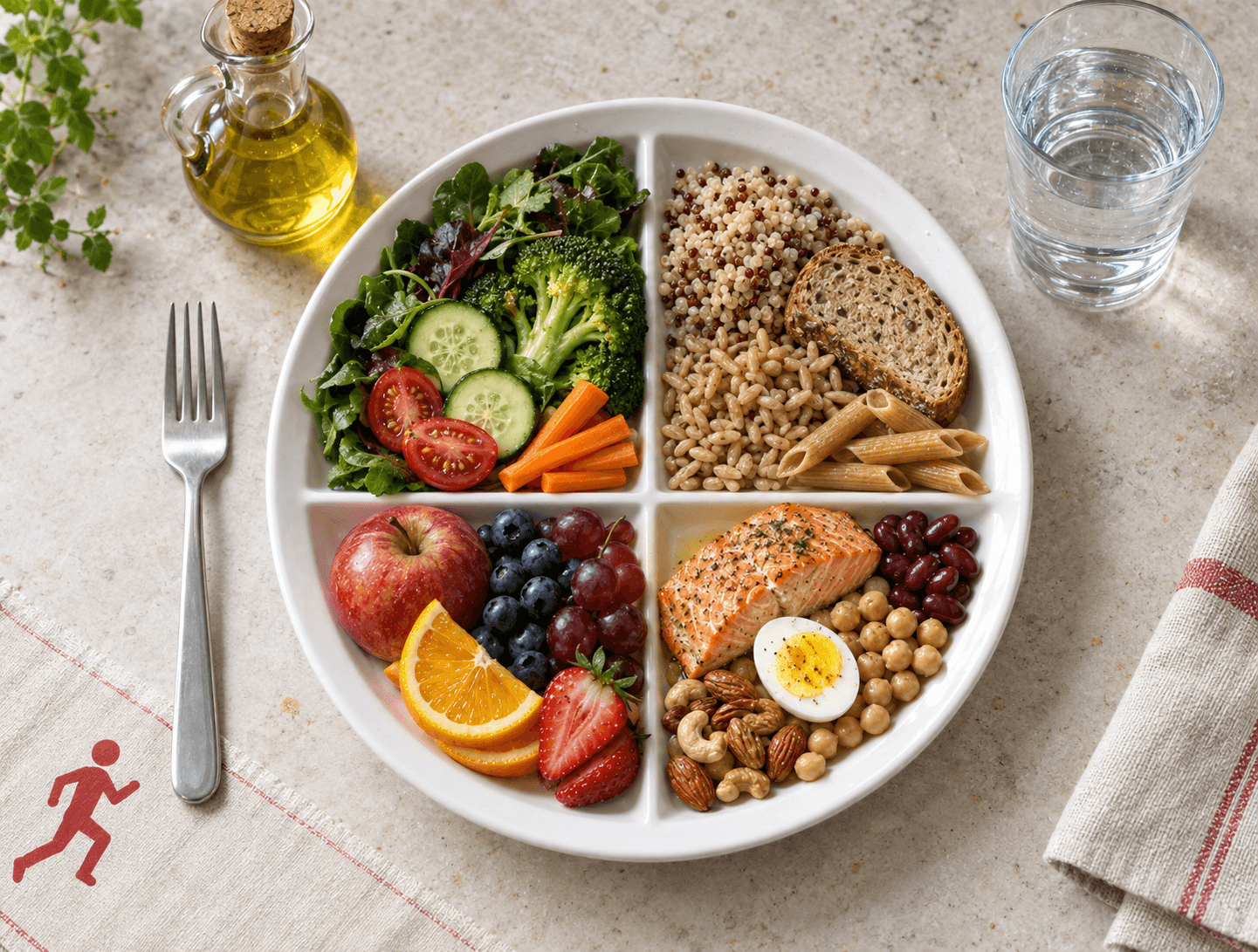
Start with vegetables
Add protein and healthy fats
Save carbs for last
It’s an easy, no-cost tweak with proven short-term benefits — but it’s not a magic bullet. The real foundations of health are still balanced nutrition, portion control, and regular movement.
Final Thoughts
Meal sequencing is a fascinating tool: it clearly changes how the body processes carbs in the moment. But the long-term health impact isn’t yet clear, especially for people without blood sugar issues.
Consider it a bonus strategy — one that works best alongside healthy eating habits, not instead of them.
For personalised nutrition advice, book a Consultation — together we can create a plan tailored to your health goals.
Reference List:
Al-Mssallem, MQ, Frost, G & Brown, JE (2024) 'Postprandial glucose and insulin response to meal sequence among healthy UAE adults: a randomized controlled crossover trial', Nutrition and Health, vol. 30, no. 2, pp. 267-274. Available at: https://pubmed.ncbi.nlm.nih.gov/39559800/
Aswathi, A et al. (2020) 'The impact of food order on postprandial glycemic excursions in prediabetes', Diabetes & Metabolic Syndrome: Clinical Research & Reviews, vol. 14, no. 5, pp. 1591-1595. Available at: https://pmc.ncbi.nlm.nih.gov/articles/PMC7398578/
Flood, JE & Rolls, BJ (2007) 'Soup preloads in a variety of forms reduce meal energy intake', Appetite, vol. 49, no. 3, pp. 626-634. Available at: https://doi.org/10.1016/j.appet.2007.07.002
Gentilcore, D et al. (2006) 'Effects of fat on gastric emptying of and the glycemic, insulin, and incretin responses to a carbohydrate meal in type 2 diabetes', Journal of Clinical Endocrinology & Metabolism, vol. 91, no. 6, pp. 2062-2067. Available at: https://academic.oup.com/jcem/article/91/6/2062/2843371
Imai, S, Fukui, M & Kajiyama, S (2013) 'Eating vegetables before carbohydrates improves postprandial glucose excursions', Diabetic Medicine, vol. 30, no. 4, pp. 469-475. Available at: https://pmc.ncbi.nlm.nih.gov/articles/PMC3674531/
Jakubowicz, D et al. (2014) 'Incretin, insulinotropic and glucose-lowering effects of whey protein pre-load in type 2 diabetes: a randomised clinical trial', Diabetologia, vol. 57, no. 9, pp. 1807-1811. Available at: https://link.springer.com/article/10.1007/s00125-014-3305-x
Kajiyama, S et al. (2023) 'Dividing carbohydrate intake evenly for meals improves postprandial glucose in patients with type 2 diabetes: A randomized crossover trial', Journal of Nutritional Science, vol. 12, e18. Available at: https://doi.org/10.1017/jns.2023.12
Lu, JC et al. (2019) 'Postprandial glucose, insulin and incretin responses differ by test meal macronutrient ingestion sequence (PATTERN study)', Clinical Nutrition, vol. 38, no. 6, pp. 2617-2623. Available at: https://www.sciencedirect.com/science/article/abs/pii/S0261561419301542
Ma, J et al. (2009) 'Effects of a protein preload on gastric emptying, glycemia, and gut hormones after a carbohydrate meal in diet-controlled type 2 diabetes', Diabetes Care, vol. 32, no. 9, pp. 1600-1602. Available at: https://diabetesjournals.org/care/article/32/9/1600/28666/Effects-of-a-Protein-Preload-on-Gastric-Emptying
Nauck, MA & Meier, JJ (2018) 'Incretin hormones: Their role in health and disease', Diabetes, Obesity and Metabolism, vol. 20, supplement 1, pp. 5-21. Available at: https://doi.org/10.1111/dom.13129
Okami, Y et al. (2022) 'Efficacy of a meal sequence in patients with type 2 diabetes: a systematic review and meta-analysis', BMJ Open Diabetes Research and Care, vol. 10, no. 1, e002747. Available at: https://pmc.ncbi.nlm.nih.gov/articles/PMC8883221/
Rayner, CK et al. (2001) 'Relationships of upper gastrointestinal motor and sensory function with glycemic control', Diabetes Care, vol. 24, no. 2, pp. 371-381. Available at: https://doi.org/10.2337/diacare.24.2.371
Reynolds, AN, Akerman, AP & Mann, J (2020) 'Dietary fibre and whole grains in diabetes management: systematic review and meta-analyses', PLoS Medicine, vol. 17, no. 3, e1003053. Available at: https://doi.org/10.1371/journal.pmed.1003053
Rolls, BJ, Roe, LS & Meengs, JS (2004) 'Salad and satiety: energy density and portion size of a first-course salad affect energy intake at lunch', Journal of the American Dietetic Association, vol. 104, no. 10, pp. 1570-1576. Available at: https://doi.org/10.1016/j.jada.2004.07.001
Shukla, AP et al. (2015) 'Food order has a significant impact on postprandial glucose and insulin levels', Diabetes Care, vol. 38, no. 7, pp. e98-e99. Available at: https://pmc.ncbi.nlm.nih.gov/articles/PMC4876745/
Shukla, AP et al. (2017) 'Carbohydrate-last meal pattern lowers postprandial glucose and insulin excursions in type 2 diabetes', BMJ Open Diabetes Research and Care, vol. 5, no. 1, e000440. Available at: https://pmc.ncbi.nlm.nih.gov/articles/PMC5604719/
Tahavorgar, A et al. (2023) 'Whey protein premeal lowers postprandial glucose concentrations in adults compared with water—the effect of timing, dose, and metabolic status: a systematic review and meta-analysis', American Journal of Clinical Nutrition, vol. 117, no. 3, pp. 528-545. Available at: https://ajcn.nutrition.org/article/S0002-9165(23)48905-8/fulltext
Tricò, D et al. (2022) 'Ordered eating and its effects on various postprandial health markers: a systematic review', Food & Function, vol. 13, no. 23, pp. 12111-12125. Available at: https://pubmed.ncbi.nlm.nih.gov/36574255/
Yabe, D et al. (2019) 'Dietary instructions focusing on meal-sequence and nutritional balance for prediabetes subjects: An exploratory, cluster-randomized, prospective, open-label, clinical trial', Journal of Diabetes Investigation, vol. 10, no. 6, pp. 1519-1526. Available at: https://www.sciencedirect.com/science/article/pii/S105687271930621X
Blogs and Insights